Notice Educational use only. CompoundProfile publishes evidence summaries. This is not medical advice and does not constitute a recommendation to use any compound.
CHS-AI Agent CompoundPurity.ca
Peptides · 54 Compounds
5-Amino-1MQ
50 mg
AOD-9604
AURA Blend
15 mg
BPC-157
5 mg
BPC-157 + TB-500 Blend
10 mg
CJC-1295 + Ipamorelin
7 mg
CJC-1295 No DAC
2 mg
CJC-1295 With DAC
2 mg
DIHEXA
--
DSIP
5 mg
Epithalon
10 mg
FOLLISTATIN-344
--
FOXO4-DRI
--
GHK-Cu
50 mg
GHRP-2
5 mg
GHRP-6
5 mg
GLP-1 / Semaglutide
1 mg
GLP-2 / Teduglutide
Glutathione
200 mg
GONADORELIN
--
HEXARELIN
100–200 mcg
IGF-LR3
Ipamorelin
5 mg
Kisspeptin
Kisspeptin-10
KLOW Blend
10 mg
KPV
LIRAGLUTIDE
--
Melanotan I
10 mg
Melanotan II
10 mg
Metabolic Blend
10 mg
MK-677
--
MOTS-C
NAD+
Pancragen
PEG-MGF
--
Pinealon
PT-141
10 mg
Regeno Blend
Retatrutide
Selank
Selank + Semax Blend
10 mg
Semax
Sermorelin
SS-31 (Elamipretide)
TB-500
Tesamorelin
Tesamorelin + Ipamorelin
Thymagen
Thymosin Alpha-1
TIRZEPATIDE
--
Vesugen
Vilon
VIP
--
Compound Profile Longevity

FOXO4-DRI

FOXO4-D-Retro-Inverso peptide · Senolytic peptide · D-retro-inverso FOXO4 FH domain
Compound Health Score
Professionals vs Social Media
18%
Evidence
ICPS Evidence Score
Compound Health Score · CHS-AI Agent
55%
Popularity
Public Sentiment
Compound Health Score · CHS-AI Agent
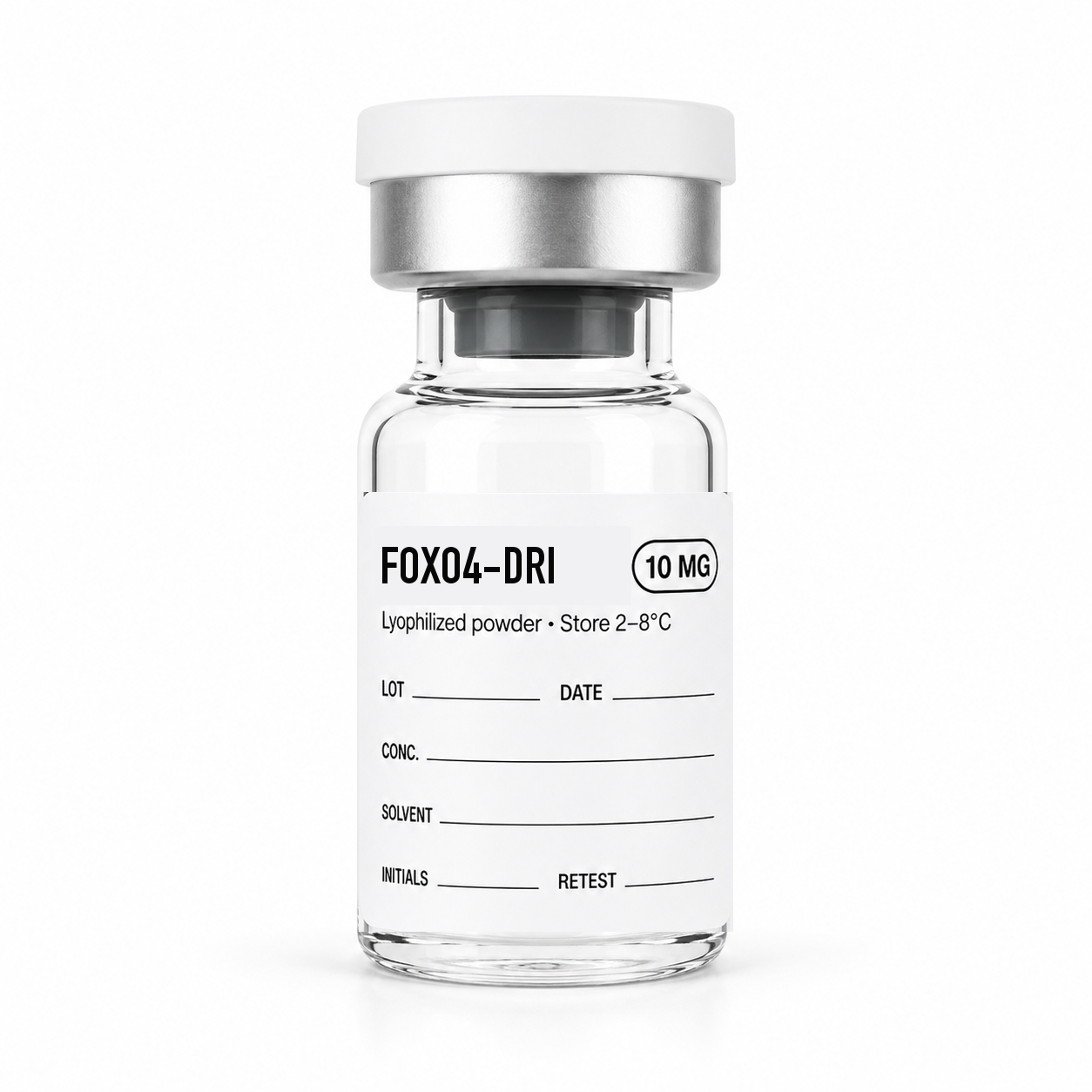
FOXO4-DRI peptide vial
Non Peer-Reviewed Claims Longevity biohackers market FOXO4-DRI as a 'zombie cell killer' that selectively eliminates senescent cells — claiming it reverses aging, restores hair, improves fitness, reverses organ dysfunction, and produces dramatic rejuvenation based on the 2017 mouse paper results. Some vendors claim human users report striking anti-aging results.

FOXO4-DRI is a 46-amino-acid D-retro-inverso (DRI) peptide that mimics the FOXO4 forkhead domain, competing with endogenous FOXO4 for p53 binding. Senescent cells survive by relying on the FOXO4-p53 interaction to suppress apoptosis; disrupting this interaction selectively triggers apoptosis in senescent cells while sparing normal proliferating cells. The 2017 van Deursen lab Nature Medicine paper generated enormous excitement — but human data does not exist.

Public Discourse
The selective elimination of senescent cells by FOXO4-DRI in mice produced striking results — improved fitness, fur density, renal function, and chemotherapy-induced frailty. We were careful not to overclaim translation to humans. The compound has promise as a research tool and therapeutic lead, but the gap from mouse model to human therapy is substantial.
Jan van Deursen PhD, Mayo Clinic — senior author of 2017 FOXO4-DRI Nature Medicine paper — Nature Medicine, 2017
Longevity research perspective , Fight Aging analysis — Post-2017, FOXO4-DRI has seen continued publication activity: keloid fibroblasts, endothelial senescence, chondrocyte studies. The mechanism is being refined. Human clinical application remains far off — toxicity, delivery, and selectivity in the human senescent cell landscape are all open questions.
— Fight Aging , 2026
Self-experimentation report , r/longevity community — High-dose protocols (1mg/kg equivalent estimated) are circulating in biohacker forums. Reports range from 'no discernible effect' to 'felt sick for 3 days.' No validated biomarkers of senescent cell clearance used. The therapeutic window in humans is completely unknown.
— r/longevity , 2024
ICPS Effective Score
0.8 / 5
Overall
Animal Evidence
2
Human Trials
0
Safety Profile
1
Regulatory Status
0
ICPS Assessment · August 2026
Public Sentiment Score
AI-Derived · Claude Analysis
i
55%
Mixed Sentiment
Reddit · Forums
58%
Podcasts · Video
55%
Biohacker Blogs
52%
Medical Press
42%
Claude AI · Training data through May 2025
Full methodology ↗
AI Sentiment Score — Methodology

What this score measures

The Public Sentiment Score reflects how positively the broader community discusses this compound across public sources. It is distinct from the ICPS Evidence Score, which assesses clinical and peer-reviewed evidence quality.

A high sentiment score does not indicate safety or efficacy. It indicates community enthusiasm, which may or may not align with the scientific evidence.

Data sources

Reddit (r/Peptides, r/Nootropics, r/Biohacking)40% weight
Podcasts & Video (JRE, Huberman Lab, etc.)25% weight
Biohacker blogs & forums (Longecity, etc.)20% weight
Medical & mainstream press15% weight

Limitation: This score is derived from Claude AI training data with a cutoff of May 2025. It cannot account for sentiment shifts after that date. This score is not an endorsement of any compound, nor a substitute for clinical evidence.

Full methodology page ↗ CompoundProfile · ICPS

Quick Facts

AA Length
46 amino acids (all D-amino acids, reversed sequence)
Type
D-Retro-Inverso (DRI) peptide — designed for enzymatic stability and cell penetration
MW
~5,500 Da (estimated; synthesis-dependent)
Half-Life
Extended vs L-amino acid peptides due to D-configuration; enzymatic resistance in plasma
Cell Penetrating
Contains CPP (cell-penetrating peptide) domain for nuclear access
Routes
Subcutaneous or IP injection (rodent studies); human route not established
Origin
van Deursen lab, Mayo Clinic — published Nature Medicine 2017
Regulatory
Not FDA approved; no IND status; research only
Target
FOXO4-p53 protein-protein interaction in senescent cells
Synthesis Cost
Very high (46 D-amino acids); limits research availability and purity

Plain-English Summary

Cellular senescence is a state where cells permanently exit the cell cycle but resist apoptosis and secrete a pro-inflammatory 'senescence-associated secretory phenotype' (SASP). Senescent cells accumulate with aging and after stress (chemotherapy, radiation, chronic disease) and are believed to drive aging-related tissue dysfunction through their inflammatory secretome.

FOXO4-DRI was designed to exploit a vulnerability specific to senescent cells: their survival depends on the FOXO4-p53 interaction, which suppresses p53-mediated apoptosis. The D-retro-inverso modification (all D-amino acids in reversed sequence) makes the peptide structurally mimic the FOXO4 forkhead domain while being resistant to protease degradation — critical for a peptide that needs to penetrate cells and reach the nucleus.

The 2017 Nature Medicine paper (Baar et al.) showed that FOXO4-DRI treatment in naturally aged mice and chemotherapy-damaged mice produced clearance of p21-positive senescent cells from liver, intestine, and kidney, accompanied by improved fitness (treadmill running), restoration of fur density and coat quality, and partial recovery of renal function. These results were striking — arguably the most dramatic pharmacological anti-aging findings in a mouse model up to that point.

As of 2026, human clinical trial data does not exist. The compound remains in early preclinical research. Key open questions include: (1) Does the FOXO4-p53 pathway have the same role in human senescent cell survival as in mice? (2) What is the therapeutic window — at what dose does FOXO4-DRI become toxic to non-senescent cells? (3) What is the appropriate biomarker to confirm senescent cell clearance in a human trial? The synthesis cost and technical complexity of producing GMP-quality 46-AA D-peptides are also significant barriers.

The 2017 mouse paper results are genuinely exciting by the standards of aging biology. But translating mouse aging phenotype rescue to human anti-aging benefit has a notoriously poor track record. Senescent cell biology differs between species, tissues, and age-related contexts. Self-experimenting with FOXO4-DRI outside of a clinical trial means using a compound with no human safety data, uncertain purity (46 D-amino acid synthesis is technically demanding), and no validated way to measure whether it is working.

Mechanism of Action

Proposed mechanisms below are derived from in vitro and rodent studies only. No mechanistic pathway has been validated in a controlled human study.

Step 01
FOXO4 FH Domain Mimicry
FOXO4-DRI mimics the forkhead (FH) domain of FOXO4, competing with endogenous FOXO4 for binding to p53. Because the peptide uses D-amino acids in reversed sequence, it retains the binding surface but is protease-resistant.
Step 02
p53 Nuclear Exclusion
Disruption of FOXO4-p53 interaction releases p53 from nuclear retention in senescent cells. Free p53 translocates to the cytoplasm, where it triggers mitochondrial apoptosis pathways (Bax/Bcl-2 pathway) specifically in cells that depend on this interaction for survival.
Step 03
Selective Senescent Cell Apoptosis
Normal proliferating cells are spared because they do not rely on FOXO4-p53 interaction for survival. The selectivity has been validated in vitro and in mouse models, but the degree of selectivity in the complex human tissue environment is unknown.
Step 04
SASP Reduction
Elimination of senescent cells reduces secretion of pro-inflammatory cytokines (IL-6, IL-8, MMPs) that drive age-related tissue dysfunction, chronic inflammation, and cancer promotion — the proposed mechanism for anti-aging effects.

All mechanistic data is derived from in vitro or rodent studies. Applicability of these pathways in humans is not established.

Animal Data

ModelFindingICPS Status
Naturally aged mice (24 months) FOXO4-DRI (5mg/kg 3x/week × 10 days IP) cleared p21+ senescent cells from liver/gut/kidney; improved exercise tolerance, fur density, renal function vs PBS controls. Baar et al. 2017 ↗ Preclinical
Chemotherapy-damaged mice FOXO4-DRI restored hematopoietic progenitor cell numbers and improved physical fitness in cisplatin-damaged mice — demonstrating utility in treatment-induced senescence, not just aging. Preclinical
Keloid fibroblasts (in vitro / ex vivo) FOXO4-DRI induced apoptosis in keloid senescent fibroblasts with relative sparing of normal dermal fibroblasts. Nature Communications Biology 2025 ↗ Preclinical

No finding from this section has been replicated in a controlled human trial. Animal-to-human translation for peptides is uncertain and cannot be assumed.

Human Trials

TrialPopulationStatusICPS Status
No human trials No Data
Preclinical stage Mouse aging models Preclinical
Emerging mechanism research In vitro / ex vivo Emerging

FOXO4-DRI has no FDA, EMA, or Health Canada–approved indications and no published Phase III trial data for any condition as of 2026.

Safety & Side Effects

Short-Term (Limited Data)

No human safety data exists. In mouse studies at therapeutic doses, FOXO4-DRI was tolerated without gross toxicity in aged and chemo-damaged mice. However, mice do not necessarily predict human toxicity for complex mechanisms like selective apoptosis induction. Key theoretical concern: if selectivity is imperfect in humans, FOXO4-DRI could induce apoptosis in non-senescent cells (bone marrow progenitors, gut epithelium, liver hepatocytes) with serious consequences.

Long-Term Unknown

Synthesis quality is a critical risk factor. Producing 46 D-amino acid peptides with correct chirality and sequence requires advanced SPPS techniques. Analytical verification is challenging. Most vendors selling 'FOXO4-DRI' cannot guarantee the quality of their product meets research-grade standards, let alone human-grade.

Self-Reported
  • Unknown — no systematic human AE data
  • Potential off-target apoptosis in non-senescent cells (theoretical)
  • Injection site reactions
  • Reported: flu-like symptoms in some self-experimenters (may indicate immune response)
Avoid If
  • Active cancer or cancer treatment (pro-apoptotic mechanism could interact with chemotherapy)
  • Pregnancy or breastfeeding
  • Children and adolescents
  • Autoimmune conditions (Treg populations may be affected)
  • Any condition where non-selective apoptosis would be dangerous
Not Approved

FOXO4-DRI is not approved by the FDA, EMA, or Health Canada for any medical indication. It is classified as a research compound and is not legal for human therapeutic use in most jurisdictions. Procurement and use outside of registered clinical trials carries regulatory and unknown health risks.

References

Research disclaimer. CompoundProfile publishes summaries of available scientific literature for educational purposes only. This page does not constitute medical advice and should not be interpreted as an endorsement of FOXO4-DRI for any therapeutic use. Consult a licensed healthcare professional before considering any research compound. All evidence gradings reflect the state of published literature as of August 2026 and are assessed independently by ICPS.

Field Notes

Community Commentary

Selected discussion from r/Peptides · Curated for signal, not volume

u/longevity_biohacker r/longevity ~200 days ago

Ran FOXO4-DRI 1mg 3x/week for 3 weeks. Protocol based on the Baar 2017 dosing scaled to human weight. Felt tired and somewhat flu-ish days 2–4 after each injection then cleared. No validated biomarker to know if anything actually happened. The senescence clearance narrative is compelling. The evidence it worked in me: zero.

u/aging_researcher r/longevity ~120 days ago

The 2017 paper is legit. I work in aging biology. The mouse model is solid. But 'works in a mouse' to 'works in a human' is a chasm we fall into all the time in this field. Senescent cell heterogeneity in humans is enormous — different tissues, different survival mechanisms, different FOXO4 dependence. Don't extrapolate.

u/synthesis_quality r/longevity ~60 days ago

46 D-amino acid peptides are genuinely hard to make correctly. I contacted two suppliers about their FOXO4-DRI and neither could provide mass spec data confirming D-amino acid incorporation at each position. You might be buying junk or L-amino acid sequence that degrades in minutes in plasma.

u/van_deursen_fan r/longevity ~30 days ago

The follow-up papers since 2017 show the mechanism is real in multiple tissue contexts. Keloids, cartilage, endothelium. The biology is being confirmed. The step to human clinical trial is what we need. Someone needs to fund a Phase I safety study — that's the bottleneck.

Purity Registry
CompoundPurity.ca
Independent vendor purity registry. Aggregated test data, HPLC results, and Health Canada violation records. No paid placements.
Search the registry ↗
COA Ledger
CompoundLedger.org
Blockchain-anchored certificates of analysis. Permanent, tamper-proof test records. Every COA hashed on issuance — no record can be altered after publication.
View blockchain records ↗
Governing Standards
ICPS Standards
International Compound Purity Standards. The independent, non-commercial standards body governing all testing methodology, evidence assessment, and registry classifications across the ICPS platform.
Read the standards ↗