Quick Facts
Plain-English Summary
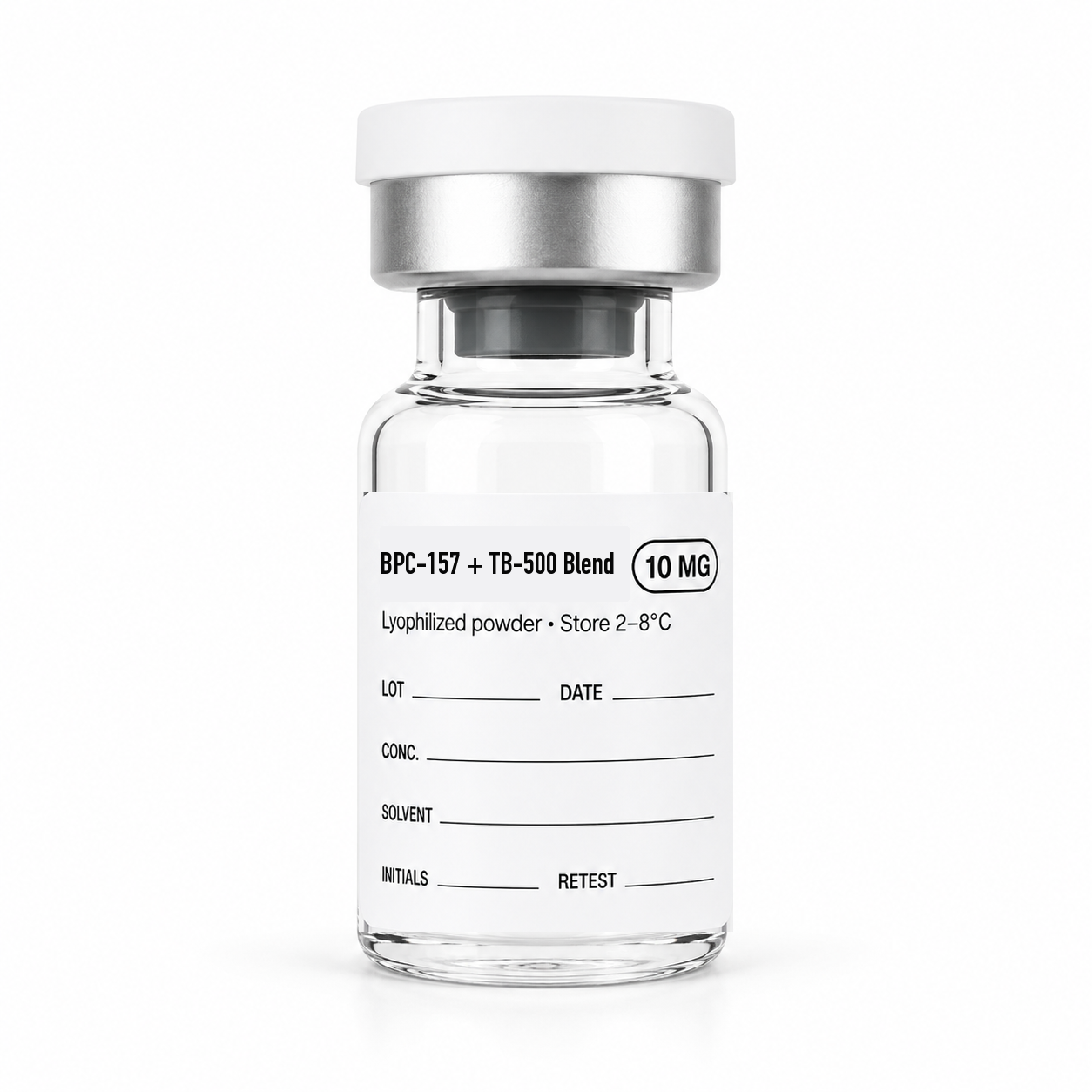
The BPC-157 + TB-500 blend combines two of the most widely researched tissue repair peptides in a single lyophilised vial. BPC-157, derived from gastric juice, is understood to promote local angiogenesis, tendon-to-bone healing, and gut mucosal repair. TB-500, the synthetic analogue of Thymosin Beta-4's active fragment, facilitates cell migration via actin sequestration and has shown cardiac and dermal repair properties.
The rationale for combining them is mechanistic complementarity: BPC-157 acts locally at injury sites while TB-500 promotes systemic cell migration and broader angiogenic signalling. No studies have examined this specific combination in humans or animals; all evidence is extrapolated from individual component research.
No peer-reviewed study has examined BPC-157 and TB-500 together as a formulated blend. All claimed synergistic effects are theoretical extrapolations from separate research programmes. Combination-specific pharmacokinetics, interactions, and efficacy data do not exist.
Both individual components have extensive rodent preclinical data but extremely limited human trial evidence. The combination is among the most popular peptide stacks in biohacking communities, driven by the plausible — but unproven — hypothesis that complementary mechanisms produce additive or synergistic healing effects.
Mechanism of Action
Proposed mechanisms below are derived from in vitro and rodent studies only. No mechanistic pathway has been validated in a controlled human study.
All mechanistic data is derived from in vitro or rodent studies. Applicability of these pathways in humans is not established.
Animal Data
| Model | Finding | ICPS Status |
|---|---|---|
| BPC-157 — Rat tendon transection | Near-complete tendon healing at 4 weeks vs. untreated controls. Effect dose-dependent (1–10 μg/kg). Strong rodent evidence for BPC-157 component. Staresinic et al. 2003 ↗ | Preclinical |
| TB-500 — Equine tendon injury | Thymosin Beta-4 demonstrated accelerated tendon repair in equine models — the strongest non-rodent animal evidence for the TB-500 component. Smith et al. 2007 ↗ | Preclinical |
| TB-500 — Rat cardiac repair | Thymosin Beta-4 promoted epicardial progenitor mobilisation and cardiac repair post-infarction in rodent models. Demonstrates systemic cell migration mechanism distinct from BPC-157. Smart et al. 2007 ↗ | Preclinical |
| BPC-157 — Rat colitis (TNBS) | Significant reduction in colonic inflammation markers and mucosal damage score across multiple colitis models. Consistent with BPC-157 GI cytoprotective mechanism. | Preclinical |
| BPC-157 + TB-500 Blend | No preclinical studies have specifically examined the blend formulation. Combination effects remain entirely extrapolated from individual component research programmes. | No Data |
No finding from this section has been replicated in a controlled human trial. Animal-to-human translation for peptides is uncertain and cannot be assumed.
Human Trials
| Trial | Population | Status | ICPS Status |
|---|---|---|---|
| BPC-157 + TB-500 Combination | — | — | No Data |
| BPC-157 — Phase II (Ulcerative Colitis) | 62 patients, oral BPC-157 vs. placebo, 4 weeks | — | Incomplete |
| TB-500 — Early-phase trials | Limited wound healing and cardiac applications | — | Early Phase |
BPC-157 + TB-500 Blend has no FDA, EMA, or Health Canada–approved indications and no published Phase III trial data for any condition as of 2026.
Safety & Side Effects
No combination safety data exists. Individually, both peptides appear well tolerated in animal studies with minimal reported adverse effects in human anecdotal use. Combination-specific pharmacokinetics and interaction profiles are entirely unknown.
Theoretical risks include unintended angiogenic promotion given VEGF upregulation from both components, and unknown pharmacokinetic interactions. Pro-angiogenic mechanisms could theoretically accelerate tumour vascularisation in individuals with existing or undetected malignancy.
- Injection site redness and mild soreness
- Transient headache in initial days of use
- Mild nausea, especially at higher doses
- Vivid dreams (mechanism unknown; reported with BPC-157)
- No pharmacovigilance database exists for either compound
- Sterile preparation and verified purity are critical given unregulated status
- Active or suspected malignancy
- Pregnancy or breastfeeding
- Immunosuppressive therapy
- Hormone-sensitive conditions
- Children and adolescents
- Any condition where angiogenic promotion may be contraindicated
BPC-157 + TB-500 Blend is not approved by the FDA, EMA, or Health Canada for any medical indication. It is classified as a research compound and is not legal for human therapeutic use in most jurisdictions. Procurement and use outside of registered clinical trials carries regulatory and unknown health risks.
References
Research disclaimer. CompoundProfile publishes summaries of available scientific literature for educational purposes only. This page does not constitute medical advice and should not be interpreted as an endorsement of BPC-157 + TB-500 Blend for any therapeutic use. Consult a licensed healthcare professional before considering any research compound. All evidence gradings reflect the state of published literature as of September 2026 and are assessed independently by ICPS.
Community Commentary
Selected discussion from r/Peptides · Curated for signal, not volume
Running BPC-157 + TB-500 blend post-shoulder surgery. 6 weeks in, inflammation is down and range of motion returned faster than my previous surgery without peptides. Hard to isolate variables but I'm convinced.
The mechanistic case for stacking is solid even without combination studies. BPC-157 for local vascularisation, TB-500 for cell migration. Theoretically they hit different phases of healing.
This is my go-to post-injury protocol now. Done 3 cycles over 2 years for different injuries. Each time, healing pace felt accelerated compared to my baseline. Sample size of 1, obviously.
Worth noting: the "2x faster healing" claims have zero evidence behind them specifically for the blend. You're stacking two compounds with limited human data and calling it synergy. The biology is plausible but that's different from proven.
Fair point. I don't claim it's proven. But n=1 is better than n=0 and the risk profile seems low.
One thing people overlook with blends: you lose the ability to titrate each compound independently. If you react to something, you don't know which one. Individual dosing gives more control.