Quick Facts
Plain-English Summary
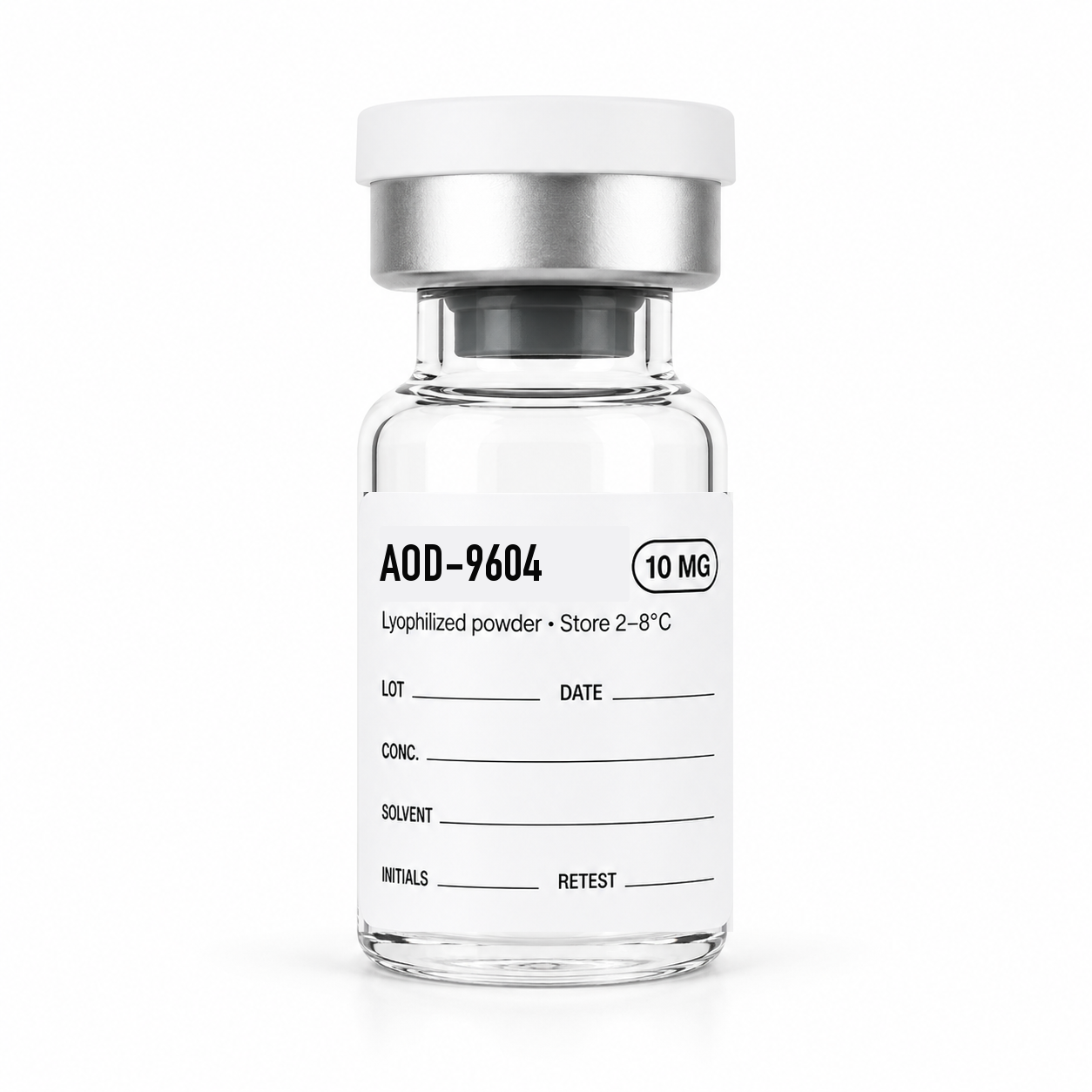
AOD-9604 is a synthetic peptide comprising the C-terminal 16 amino acids of human growth hormone (residues 177–191), with a disulfide bridge added for structural stability. It was developed by Metabolic Pharmaceuticals in Australia during the 1990s with the specific goal of retaining the lipolytic (fat-burning) activity of full hGH while eliminating the growth-promoting, diabetogenic, and IGF-1-raising effects that make long-term hGH use problematic.
The central premise is well-grounded in early molecular biology research. Work by Ng FM and colleagues in the late 1980s and 1990s identified that the C-terminal region of hGH — not the receptor-binding domain — is responsible for the lipolytic effect observed in adipose tissue. Full hGH is a bifunctional molecule: its N-terminal region drives anabolic growth via the GH receptor, while its C-terminal region independently modulates fat metabolism. AOD-9604 was engineered to isolate and amplify that second function.
In animal models, AOD-9604 demonstrated consistent fat reduction in obese rodents without the metabolic side-effects of full hGH — no elevated blood glucose, no IGF-1 elevation, no significant change in lean mass. These findings supported progression to human trials. However, when Metabolic Pharmaceuticals conducted Phase II studies in obese patients, the compound showed modest visceral fat reduction that failed to reach statistical significance versus placebo at levels sufficient for regulatory approval. The programme did not advance to Phase III.
Critical regulatory clarification: AOD-9604 has received FDA GRAS (Generally Recognized As Safe) status — but only for use as a food ingredient at very low oral doses. GRAS is a food-safety classification, not a drug approval. It does not authorise the compound for injectable therapeutic use, does not validate any weight-loss indication, and is routinely misrepresented by vendors and online sources as equivalent to FDA drug approval. It is not.
Separately from its metabolic profile, animal studies have reported cartilage repair properties for AOD-9604 — an observation that emerged independently of the fat-loss programme. This has attracted research interest in osteoarthritis contexts, though human evidence for this indication is absent as of 2026.
Mechanism of Action
Proposed mechanisms below are derived from in vitro and rodent studies only. No mechanistic pathway has been validated in a controlled human study.
All mechanistic data is derived from in vitro or rodent studies. Applicability of these pathways in humans is not established.
Animal Data
| Model | Finding | ICPS Status |
|---|---|---|
| Obese mouse model (ob/ob) | Significant reduction in body fat mass compared to vehicle-treated controls at doses of 250–500 μg/kg/day. No significant effect on lean body mass, blood glucose, or IGF-1 levels. Effect not observed with equivalent doses of full hGH in glucose-clamped conditions. Heffernan et al. 2000 ↗ | Preclinical |
| Diet-induced obese rat | Visceral fat reduction and improved adipokine profile versus control. No insulin resistance observed. Effect size comparable to caloric restriction group at equivalent duration. Heffernan et al. 2000 ↗ | Preclinical |
| Rat cartilage defect model | Accelerated cartilage repair observed at defect sites with intra-articular AOD-9604 administration. Histological scoring showed increased proteoglycan deposition and chondrocyte organisation. Mechanism proposed to involve TGF-β signalling. Independent of lipolytic pathway. | Preclinical |
| Metabolic safety (multiple species) | No tumourigenicity, genotoxicity, or organ toxicity at doses up to 1,000× the proposed human dose in rodent and primate studies submitted for GRAS review. These data underpinned the FDA GRAS food ingredient classification. | Preclinical |
No finding from this section has been replicated in a controlled human trial. Animal-to-human translation for peptides is uncertain and cannot be assumed.
Human Trials
| Trial | Population | Status | ICPS Status |
|---|---|---|---|
| Phase II — Obesity Metabolic Pharmaceuticals, Australia | Obese adults; multiple-dose cohorts; subcutaneous AOD-9604 vs. placebo; 12–24 weeks | — | Marginal · Not Approved |
| All other indications | — | — | No Data |
AOD-9604 has no FDA, EMA, or Health Canada–approved indications and no published Phase III trial data for any condition as of 2026.
Safety & Side Effects
Extensive preclinical safety package compiled for the Phase II programme and FDA GRAS submission showed no significant toxicity at doses far above the proposed human range. No mutagenicity, carcinogenicity, reproductive toxicity, or organ-specific pathology in rodent and primate models. The GRAS data package is among the more rigorous preclinical safety submissions for a research peptide.
Unlike full hGH, AOD-9604 does not raise IGF-1 levels, does not impair insulin sensitivity, and does not affect blood glucose — confirmed in both animal studies and the Phase II human trial. This profile removes the primary safety concerns associated with long-term hGH use, including acromegaly risk and diabetogenesis.
- Injection site redness and transient soreness
- Mild facial flushing shortly after injection
- Transient fatigue in early days of use
- No pharmacovigilance database exists for injectable AOD-9604
- All self-reported data is anecdotal and unverified
- Active or suspected malignancy
- Pregnancy or breastfeeding
- Paediatric populations
- Concurrent hormone therapy
- Using injectable formulations — not covered by GRAS status
AOD-9604 is not approved by the FDA, EMA, or Health Canada for any medical indication. It is classified as a research compound and is not legal for human therapeutic use in most jurisdictions. Procurement and use outside of registered clinical trials carries regulatory and unknown health risks.
References
Research disclaimer. CompoundProfile publishes summaries of available scientific literature for educational purposes only. This page does not constitute medical advice and should not be interpreted as an endorsement of AOD-9604 for any therapeutic use. Consult a licensed healthcare professional before considering any research compound. All evidence gradings reflect the state of published literature as of August 2026 and are assessed independently by ICPS.
Community Commentary
Selected discussion from r/Peptides · Curated for signal, not volume
The GRAS misrepresentation around AOD-9604 is probably the worst in the peptide space right now. I've seen vendor sites literally write "FDA approved" in the header. GRAS is a food ingredient classification. It evaluated whether a very low oral dose is safe enough to put in a food product — not whether injecting pharmacological doses for weight loss is effective or approved. The FDA's drug evaluation center had nothing to do with it. These are completely different regulatory pathways.
Right. And the dose used in the GRAS submission is ~1 mg/day orally. The self-experimentation community is using 250–500 μg subcutaneous, which is a completely different route and context. GRAS tells you nothing about injectable safety at those doses. The preclinical safety package was actually pretty solid, but the leap from "safe in rodents and GRAS-qualified for food use" to "clinically approved fat loss drug" is enormous and not supported by any regulatory decision.
The mechanistic story for AOD is actually quite coherent — Ng FM's work on the hGH C-terminal lipolytic region is legitimate science. The fragment does stimulate lipolysis and inhibit lipogenesis in vitro and in rodents, without the receptor-mediated growth effects of full hGH. That part is credible. The problem is that the human Phase II result was a soft negative — visceral fat came down a little, but not enough to clear placebo. "A little fat reduction that doesn't beat placebo in obese humans" is not a fat loss drug. The gap between mechanistic plausibility and clinical meaningfulness is the whole story here.
One thing worth flagging: the beta-3 adrenergic receptor story is interesting but underdeveloped. If AOD-9604's lipolytic mechanism runs partly through beta-3 AR, that would explain why obese human trials were underwhelming — beta-3 AR density and signalling efficiency in human adipose tissue is substantially lower than in rodents. Most beta-3 agonist drug programmes have failed in humans for the same reason. This could be a fundamental translational limitation, not just a dosing or formulation problem.
That's the honest framing. If the receptor pharmacology doesn't translate between species, the negative Phase II result makes complete mechanistic sense. The cartilage data is a separate signal entirely and might be the more interesting clinical application — but there's no human data there either, and intra-articular peptide delivery has its own set of development challenges.
Compared to the rest of the peptide space, AOD-9604 is one of the few that actually went through a real human trial programme. That deserves some credit — the data, negative as it was, is real. What doesn't deserve credit is the vendor industry's response, which was to ignore the trial result, manufacture the GRAS-equals-approval narrative, and market the compound as validated when it was specifically evaluated and not approved. The compound itself may be relatively benign; the information environment around it is not.