Notice Educational use only. CompoundProfile publishes evidence summaries. This is not medical advice and does not constitute a recommendation to use any compound.
CHS-AI Agent CompoundPurity.ca
Peptides · 54 Compounds
5-Amino-1MQ
50 mg
AOD-9604
AURA Blend
15 mg
BPC-157
5 mg
BPC-157 + TB-500 Blend
10 mg
CJC-1295 + Ipamorelin
7 mg
CJC-1295 No DAC
2 mg
CJC-1295 With DAC
2 mg
DIHEXA
--
DSIP
5 mg
Epithalon
10 mg
FOLLISTATIN-344
--
FOXO4-DRI
--
GHK-Cu
50 mg
GHRP-2
5 mg
GHRP-6
5 mg
GLP-1 / Semaglutide
1 mg
GLP-2 / Teduglutide
Glutathione
200 mg
GONADORELIN
--
HEXARELIN
100–200 mcg
IGF-LR3
Ipamorelin
5 mg
Kisspeptin
Kisspeptin-10
KLOW Blend
10 mg
KPV
LIRAGLUTIDE
--
Melanotan I
10 mg
Melanotan II
10 mg
Metabolic Blend
10 mg
MK-677
--
MOTS-C
NAD+
Pancragen
PEG-MGF
--
Pinealon
PT-141
10 mg
Regeno Blend
Retatrutide
Selank
Selank + Semax Blend
10 mg
Semax
Sermorelin
SS-31 (Elamipretide)
TB-500
Tesamorelin
Tesamorelin + Ipamorelin
Thymagen
Thymosin Alpha-1
TIRZEPATIDE
--
Vesugen
Vilon
VIP
--
Compound Profile Aesthetic Research Blend

AURA Blend

GHK-Cu (Copper Tripeptide-1) · L-Glutathione Reduced · Melanotan I (Afamelanotide) Aesthetic Research Blend · 15 mg total
Compound Health Score
Professionals vs Social Media
42%
Evidence
ICPS Evidence Score
Compound Health Score · CHS-AI Agent
72%
Popularity
Public Sentiment
Compound Health Score · CHS-AI Agent
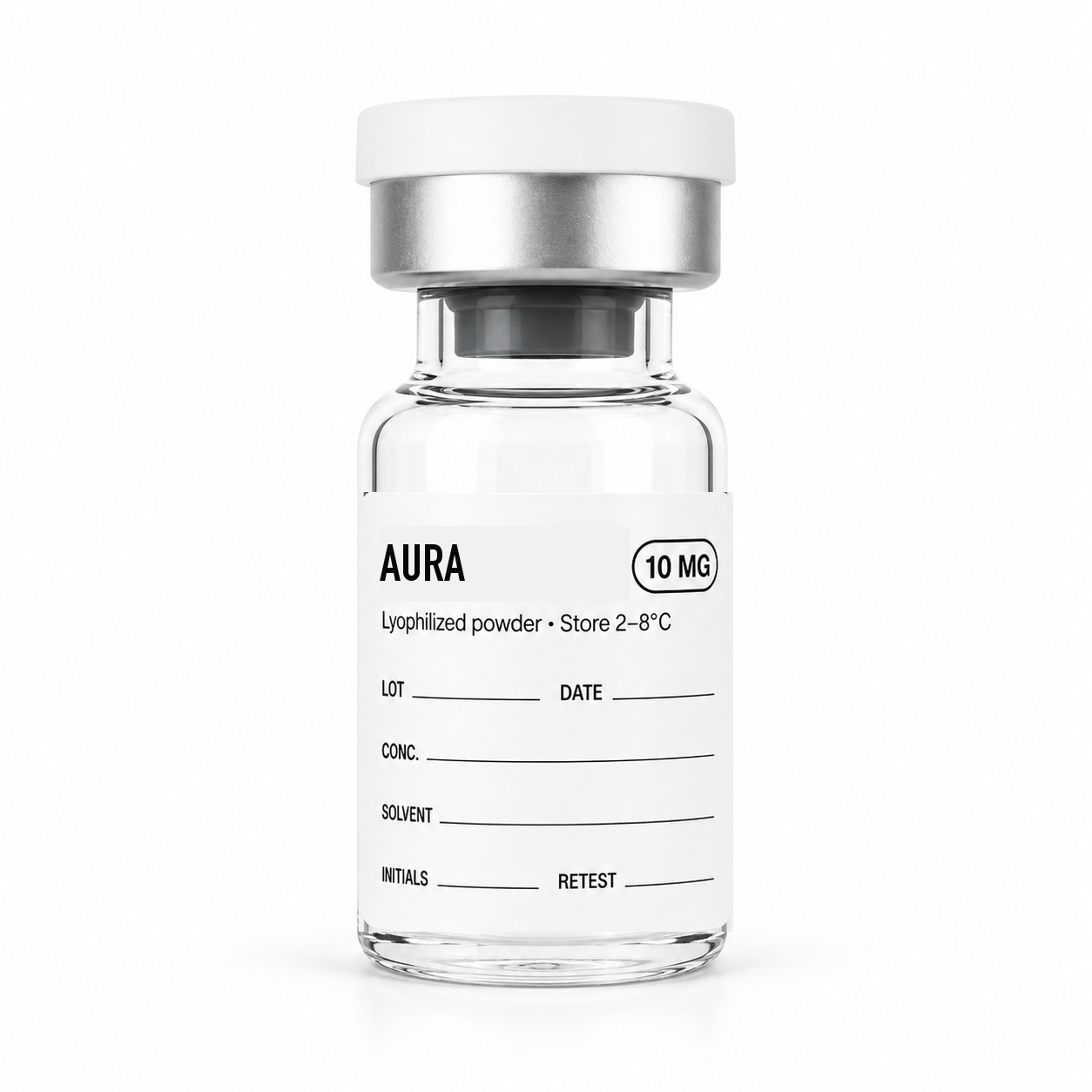
AURA Blend peptide vial
Non Peer-Reviewed Claims Vendor and influencer channels routinely describe the AURA Blend as delivering "complete skin transformation," "replacing all aesthetic treatments," and "permanently rejuvenating skin at the cellular level." As of 2026, no peer-reviewed controlled trial has evaluated this specific combination. Each component carries independent evidence for distinct mechanisms; claims about their synergistic effect as a blend are not supported by published research.

A three-component aesthetic research blend combining GHK-Cu (copper tripeptide-1) for collagen induction and wound healing, L-Glutathione Reduced for antioxidant and skin-brightening activity, and Melanotan I (Afamelanotide) for photoprotective melanogenesis via MC1R agonism. Each component has independent published evidence; no combination studies exist as of 2026. Melanotan I is FDA- and EMA-approved as Scenesse for erythropoietic protoporphyria (EPP); its use in this blend for cosmetic purposes is off-label.

Public Discourse
Rhonda Patrick , PhD, biomedical scientist and host of FoundMyFitness — has discussed GHK-Cu and glutathione in the context of skin aging, collagen synthesis, and oxidative stress reduction across multiple podcast episodes and research summaries. She has noted that while GHK-Cu shows meaningful topical and preclinical data, injectable peptide combinations for cosmetic purposes lack the controlled human trial evidence needed to draw firm efficacy conclusions.
— FoundMyFitness — Skin Aging Research Summaries , 2022–2025
Ben Greenfield , health author and biohacker — has included GHK-Cu and glutathione-adjacent compounds in his personal aesthetic and longevity peptide protocols, describing copper tripeptides as among the most evidence-backed topical and injectable agents for collagen remodelling. He has acknowledged that the AURA-style multi-compound aesthetic blend concept represents a newer extrapolation beyond what individual compound studies directly support.
— "The Best Peptide Stacks for Recovery, Fat Loss, Anti-Aging, and More" — BenGreenfieldLife.com , 2024
ICPS Effective Score
2.1 / 5
Overall
Component Evidence
3
Combination Studies
0
Safety Profile
2
Regulatory Status
3
ICPS Assessment · August 2026
Public Sentiment Score
AI-Derived · Claude Analysis
i
72%
Highly Regarded
Reddit · Forums
68%
Podcasts · Video
76%
Aesthetic Blogs
84%
Medical Press
34%
Claude AI · Training data through May 2025
Full methodology ↗
AI Sentiment Score — Methodology

What this score measures

The Public Sentiment Score reflects how positively the broader community discusses this compound across public sources. It is distinct from the ICPS Evidence Score, which assesses clinical and peer-reviewed evidence quality.

A high sentiment score does not indicate safety or efficacy. It indicates community enthusiasm, which may or may not align with the scientific evidence.

Data sources

Reddit (r/Peptides, r/Nootropics, r/Biohacking)40% weight
Podcasts & Video (JRE, Huberman Lab, etc.)25% weight
Biohacker blogs & forums (Longecity, etc.)20% weight
Medical & mainstream press15% weight

Limitation: This score is derived from Claude AI training data with a cutoff of May 2025. It cannot account for sentiment shifts after that date. This score is not an endorsement of any compound, nor a substitute for clinical evidence.

Full methodology page ↗ CompoundProfile · ICPS

Quick Facts

Blend Name
AURA Blend — Aesthetic Research Blend
Full Name
GHK-Cu + Glutathione + Melanotan I (Afamelanotide) Aesthetic Research Blend
Components
GHK-Cu (Copper Tripeptide-1) · L-Glutathione Reduced · Melanotan I (Afamelanotide)
Total Dose
15 mg blend (component ratios vendor-specific)
Evidence Note
No blend-specific research; components have independent evidence only
Route
Subcutaneous injection (research use only)
Category
Aesthetic Research · Research Blends
Regulatory
Melanotan I (Afamelanotide) approved as Scenesse for EPP (FDA/EMA). GHK-Cu and Glutathione not approved for aesthetic indications. Cosmetic blend use is off-label.
MT-I Brand
Scenesse (Clinuvel Pharmaceuticals) — approved indication: erythropoietic protoporphyria (EPP)
Combination Data
None. No published studies on this specific formulation.

Plain-English Summary

The AURA Blend is a proprietary three-component aesthetic research formulation combining GHK-Cu (copper tripeptide-1), L-Glutathione Reduced, and Melanotan I (Afamelanotide). The blend is positioned around three distinct biological pathways — collagen induction and skin regeneration, antioxidant-driven skin brightening, and photoprotective melanogenesis — each mediated by a separate component. This theoretical three-pathway framing is scientifically coherent at the component level, but as a combined formulation it has no peer-reviewed evidence of its own.

GHK-Cu is a naturally occurring tripeptide found in human plasma. Pickart and colleagues identified its wound-healing and collagen-stimulating properties across several decades of research. Unlike most research peptides, GHK-Cu has some published topical and in vitro human data, making it the component with the most accessible evidence base for skin applications specifically. Its mechanisms include upregulation of collagen and glycosaminoglycan synthesis, modulation of TGF-beta pathways, and anti-inflammatory activity.

L-Glutathione Reduced is the body's primary intracellular antioxidant. Its proposed skin-brightening mechanism operates through inhibition of tyrosinase, the enzyme that catalyses the rate-limiting step in melanin production. A small published RCT by Weschawalit et al. demonstrated skin-lightening effects via oral and topical routes, though the evidence base remains limited. Intravenous glutathione for skin brightening is used in some aesthetic markets but carries regulatory scrutiny in North America and the EU.

Melanotan I (Afamelanotide) is a synthetic analogue of alpha-melanocyte stimulating hormone (alpha-MSH). It is the only component in this blend that has achieved formal regulatory approval: Clinuvel Pharmaceuticals' Scenesse (afamelanotide 16 mg implant) is approved by the FDA and EMA for the prevention of phototoxicity in adults with erythropoietic protoporphyria (EPP). Its use in this blend for cosmetic pigmentation and photoprotection is entirely off-label. The approved mechanism — MC1R agonism driving baseline melanin synthesis — is the same mechanism exploited in off-label aesthetic applications, but efficacy and safety data from EPP populations cannot be extrapolated to general cosmetic use.

No combination studies exist for the AURA Blend formulation. Potential pharmacokinetic interactions, dose-response relationships, and additive or antagonistic effects between components are unknown. The theoretical synergy described by vendors has not been tested in any controlled research setting.

The blend's theoretical synergy rests on a logical but unproven premise: GHK-Cu and Glutathione both carry anti-inflammatory and regenerative properties, and Melanotan I's baseline melanin increase provides a photoprotective background that may reduce UV-mediated damage to skin undergoing regeneration. Whether this combination produces superior aesthetic outcomes compared to any single component — or introduces new safety concerns — remains entirely unstudied.

Mechanism of Action

Proposed mechanisms below are derived from in vitro and rodent studies only. No mechanistic pathway has been validated in a controlled human study.

Step 01
Collagen Induction & Skin Regeneration
GHK-Cu binds copper ions and activates fibroblast activity, upregulating collagen I, III, and IV synthesis alongside glycosaminoglycans. Modulates TGF-beta signalling to balance pro- and anti-fibrotic activity. Anti-inflammatory via suppression of NF-kB and TNF-alpha. Published wound-healing evidence in rodent and human topical models (Pickart series).
Step 02
Tyrosinase Inhibition & Antioxidant Activity
L-Glutathione Reduced inhibits tyrosinase, the rate-limiting enzyme in melanin biosynthesis, shifting melanogenesis from eumelanin (dark) toward phaeomelanin (light pigment). Acts as the primary intracellular antioxidant via glutathione peroxidase, neutralising reactive oxygen species generated by UV exposure and metabolic activity. Skin-brightening RCT evidence via oral route (Weschawalit et al.).
Step 03
MC1R Agonism & Photoprotective Melanogenesis
Afamelanotide is a synthetic alpha-MSH analogue that binds MC1R (melanocortin-1 receptor) on melanocytes with high affinity and extended duration. MC1R agonism drives constitutive melanin production independent of UV stimulation, increasing baseline melanin density and providing photoprotective effect. FDA- and EMA-approved for EPP via this mechanism (Scenesse). Off-label cosmetic use exploits the same pathway; approved indication is photoprotection in EPP, not cosmetic pigmentation.
Step 04
Three-Pathway Aesthetic Research Profile
Theoretical combination rationale: GHK-Cu regenerates collagen architecture while Glutathione provides antioxidant protection and tone modulation. Melanotan I's baseline melanin increase may reduce UV damage load during the regenerative phase, creating an environment where skin repair can proceed with reduced photooxidative stress. No studies have tested this synergy hypothesis. Potential for interactions — including between Glutathione's melanin suppression and Melanotan I's melanin stimulation — is uncharacterised.

All mechanistic data is derived from in vitro or rodent studies. Applicability of these pathways in humans is not established.

Animal Data

ModelFindingICPS Status

No finding from this section has been replicated in a controlled human trial. Animal-to-human translation for peptides is uncertain and cannot be assumed.

Human Trials

TrialPopulationStatusICPS Status

AURA Blend has no FDA, EMA, or Health Canada–approved indications and no published Phase III trial data for any condition as of 2026.

Safety & Side Effects

GHK-Cu — Favourable Preclinical

GHK-Cu has a well-tolerated profile in preclinical and topical human studies. Naturally occurring in human plasma at nanomolar concentrations. No significant systemic toxicity reported at research doses. Subcutaneous injection site reactions are possible.

Glutathione — Route-Dependent Risk

Oral glutathione has a benign safety profile in RCT conditions. Intravenous glutathione carries greater risk: risk of anaphylaxis, neuropathy (reported with chronic high-dose IV in some case series), and hypersensitivity reactions. IV route regulatory scrutiny is significant in Canada and the US.

Melanotan I — Nevi & Pigmentation Risk
  • Nausea and facial flushing (common, dose-dependent)
  • Spontaneous erection (less frequent than MT-II but reported)
  • Darkening of existing nevi (moles) — requires monitoring
  • New melanocytic lesion formation: theoretical concern
  • All adverse effects are from EPP trial populations
Avoid If
  • Active or suspected malignancy (any component)
  • Personal or family history of melanoma (MT-I)
  • Pregnancy or breastfeeding
  • Confirmed EPP without specialist oversight
  • Renal impairment (Glutathione clearance)
  • Children and adolescents
Not Approved

AURA Blend is not approved by the FDA, EMA, or Health Canada for any medical indication. It is classified as a research compound and is not legal for human therapeutic use in most jurisdictions. Procurement and use outside of registered clinical trials carries regulatory and unknown health risks.

References

Research disclaimer. CompoundProfile publishes summaries of available scientific literature for educational purposes only. This page does not constitute medical advice and should not be interpreted as an endorsement of AURA Blend for any therapeutic use. Consult a licensed healthcare professional before considering any research compound. All evidence gradings reflect the state of published literature as of August 2026 and are assessed independently by ICPS.

Field Notes

Community Commentary

Selected discussion from r/Peptides · Curated for signal, not volume

Purity Registry
CompoundPurity.ca
Independent vendor purity registry. Aggregated test data, HPLC results, and Health Canada violation records. No paid placements.
Search the registry ↗
COA Ledger
CompoundLedger.org
Blockchain-anchored certificates of analysis. Permanent, tamper-proof test records. Every COA hashed on issuance — no record can be altered after publication.
View blockchain records ↗
Governing Standards
ICPS Standards
International Compound Purity Standards. The independent, non-commercial standards body governing all testing methodology, evidence assessment, and registry classifications across the ICPS platform.
Read the standards ↗