Notice Educational use only. CompoundProfile publishes evidence summaries. This is not medical advice and does not constitute a recommendation to use any compound.
CHS-AI Agent CompoundPurity.ca
Peptides · 54 Compounds
5-Amino-1MQ
50 mg
AOD-9604
AURA Blend
15 mg
BPC-157
5 mg
BPC-157 + TB-500 Blend
10 mg
CJC-1295 + Ipamorelin
7 mg
CJC-1295 No DAC
2 mg
CJC-1295 With DAC
2 mg
DIHEXA
--
DSIP
5 mg
Epithalon
10 mg
FOLLISTATIN-344
--
FOXO4-DRI
--
GHK-Cu
50 mg
GHRP-2
5 mg
GHRP-6
5 mg
GLP-1 / Semaglutide
1 mg
GLP-2 / Teduglutide
Glutathione
200 mg
GONADORELIN
--
HEXARELIN
100–200 mcg
IGF-LR3
Ipamorelin
5 mg
Kisspeptin
Kisspeptin-10
KLOW Blend
10 mg
KPV
LIRAGLUTIDE
--
Melanotan I
10 mg
Melanotan II
10 mg
Metabolic Blend
10 mg
MK-677
--
MOTS-C
NAD+
Pancragen
PEG-MGF
--
Pinealon
PT-141
10 mg
Regeno Blend
Retatrutide
Selank
Selank + Semax Blend
10 mg
Semax
Sermorelin
SS-31 (Elamipretide)
TB-500
Tesamorelin
Tesamorelin + Ipamorelin
Thymagen
Thymosin Alpha-1
TIRZEPATIDE
--
Vesugen
Vilon
VIP
--
Compound Profile Performance & Recovery

PEG-MGF

Pegylated Mechano Growth Factor · PEGylated MGF · IGF-1Ec C-terminal peptide
Compound Health Score
Professionals vs Social Media
28%
Evidence
ICPS Evidence Score
Compound Health Score · CHS-AI Agent
65%
Popularity
Public Sentiment
Compound Health Score · CHS-AI Agent
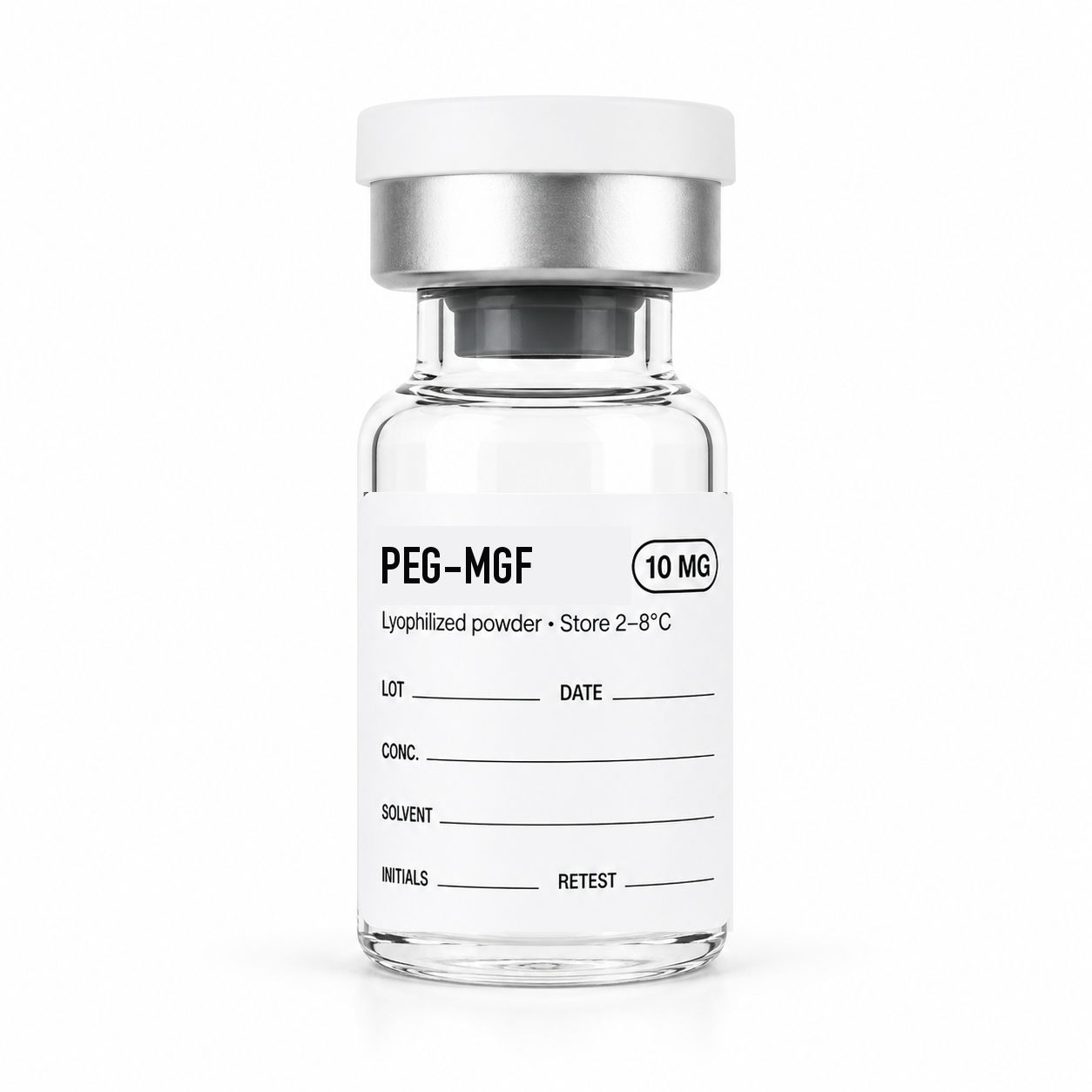
PEG-MGF peptide vial
Non Peer-Reviewed Claims Vendors market PEG-MGF as a 'muscle satellite cell activator' that dramatically accelerates recovery from training and injury. Claims include reactivating dormant satellite cells, producing localized muscle hypertrophy at injection sites, preventing muscle atrophy, and outperforming IGF-1 for muscle gain. It is often stacked with IGF-1 LR3 in bodybuilding circles.

PEG-MGF is a synthetic 24-amino-acid peptide corresponding to the C-terminal E-domain of the IGF-1Ec splice variant (mechano growth factor), conjugated to polyethylene glycol (PEG) to extend its plasma half-life from ~5–7 minutes to 48–72 hours. MGF is produced locally in skeletal muscle in response to mechanical loading and is thought to activate satellite cells — muscle stem cells critical for repair and hypertrophy.

Public Discourse
The mechano growth factor splice variant represents a fascinating example of local vs systemic IGF-1 signaling. The E-domain peptide appears to have distinct bioactivity from mature IGF-1, activating satellite cell proliferation through a non-IGF-1R mechanism. Pegylation was a logical engineering step to address the extreme instability. However, the peptide biology in human muscle repair remains very poorly characterized.
Research literature, Exercise physiology / IGF-1 splice variants — Journal of Physiology, 2016
r/Peptides bodybuilding community , Community reports — Local injection at training sites for site-specific hypertrophy is the dominant use pattern in this community. Results are highly variable and impossible to attribute specifically to PEG-MGF vs concurrent training and nutrition protocols.
— r/Peptides , 2024
Purity concern , Analytical chemistry note — PEGylated peptides present significant analytical verification challenges. PEG attachment site and chain length vary by manufacturer. Most peptide testing labs cannot easily verify PEGylation quality. Vendor products labeled 'PEG-MGF' may contain unPEGylated MGF, incomplete PEGylation, or degraded product.
— Peptide analytics literature , 2022
ICPS Effective Score
0.8 / 5
Overall
Animal Evidence
2
Human Trials
0
Safety Profile
1
Regulatory Status
0
ICPS Assessment · August 2026
Public Sentiment Score
AI-Derived · Claude Analysis
i
65%
Mixed Sentiment
Reddit · Forums
68%
Podcasts · Video
60%
Biohacker Blogs
65%
Medical Press
42%
Claude AI · Training data through May 2025
Full methodology ↗
AI Sentiment Score — Methodology

What this score measures

The Public Sentiment Score reflects how positively the broader community discusses this compound across public sources. It is distinct from the ICPS Evidence Score, which assesses clinical and peer-reviewed evidence quality.

A high sentiment score does not indicate safety or efficacy. It indicates community enthusiasm, which may or may not align with the scientific evidence.

Data sources

Reddit (r/Peptides, r/Nootropics, r/Biohacking)40% weight
Podcasts & Video (JRE, Huberman Lab, etc.)25% weight
Biohacker blogs & forums (Longecity, etc.)20% weight
Medical & mainstream press15% weight

Limitation: This score is derived from Claude AI training data with a cutoff of May 2025. It cannot account for sentiment shifts after that date. This score is not an endorsement of any compound, nor a substitute for clinical evidence.

Full methodology page ↗ CompoundProfile · ICPS

Quick Facts

AA Length
24 amino acids (MGF E-domain) + PEG conjugate
MW
~2,948 Da (base peptide); varies with PEG chain length
Half-Life
5–7 min (native MGF); ~48–72 hours (PEG-MGF)
CAS
221231-10-3 (base MGF); no standard CAS for PEGylated form
Sequence
Derived from IGF-1Ec C-terminal E-domain (24 AA)
Routes
Subcutaneous or intramuscular injection
Origin
Synthetic analogue of endogenous MGF splice variant; PEGylation added for stability
Regulatory
Not FDA/EMA approved; research compound only
Mechanism
Satellite cell activation via non-IGF-1R mechanism; distinct from systemic IGF-1
WADA Status
Prohibited — IGF-1 and its analogues/fragments are prohibited in sport

Plain-English Summary

Mechano Growth Factor is an alternatively spliced isoform of IGF-1 (the Ec variant) produced in skeletal muscle in response to mechanical stretch and damage. Unlike systemic IGF-1 (which signals via the liver), MGF is thought to act locally at sites of muscle stress to activate satellite cells — the muscle stem cells responsible for repairing damaged fibers and contributing nuclei for fiber hypertrophy.

The E-domain peptide — the 24 C-terminal amino acids of MGF — appears to have distinct bioactivity from the IGF-1 domain. In vitro, it stimulates satellite cell proliferation and delays differentiation, maintaining the proliferative pool. In rodent muscle injury models, local MGF injection accelerated satellite cell activation and improved recovery metrics. However, these are largely acute injury studies, not hypertrophy studies.

PEGylation was applied to address MGF's extremely short in vivo half-life. By conjugating polyethylene glycol chains, the plasma half-life extends from ~5 minutes to ~48–72 hours, potentially allowing twice-weekly injection rather than daily. Whether this extended half-life translates to better satellite cell activation — which may be optimally stimulated by acute local peaks rather than sustained levels — is unknown.

No human clinical trial data exists for PEG-MGF. All efficacy data is from rodent muscle injury or in vitro satellite cell studies. The compound is WADA-prohibited (IGF-1 analogues/fragments). Bodybuilding use relies entirely on the theoretical translation of rodent muscle biology to trained human athletes — a translation with no validation.

PEG-MGF purity verification is uniquely difficult. PEGylation quality varies dramatically between manufacturers, and most consumer-grade peptide testing cannot verify the PEG attachment. Users may be injecting unmodified MGF (5-minute half-life, essentially inactive by the time it reaches target tissue) or degraded product. Additionally, the WADA prohibition means competitive athletes risk anti-doping rule violations.

Mechanism of Action

Proposed mechanisms below are derived from in vitro and rodent studies only. No mechanistic pathway has been validated in a controlled human study.

Step 01
Mechanical Stretch Signal
In intact muscle, MGF is upregulated in response to eccentric load and local muscle damage. The E-domain peptide is proposed to act as a local 'alarm signal' that activates quiescent satellite cells before the IGF-1 domain signal drives their differentiation.
Step 02
Satellite Cell Activation
The MGF E-domain peptide is proposed to bind a distinct, unidentified receptor on satellite cells (not IGF-1R), triggering proliferative expansion of the satellite cell pool independent of IGF-1R signaling.
Step 03
PEGylation Pharmacokinetics
Polyethylene glycol conjugation sterically protects the peptide from plasma proteases, extending half-life from 5 minutes to 48–72 hours. PEGylation also reduces immunogenicity but may reduce receptor binding affinity depending on attachment site.
Step 04
Satellite Cell Proliferation & Repair
Activated satellite cells proliferate, fuse with damaged fibers, and donate myonuclei — increasing the nuclear domain capacity of the fiber and enabling greater protein synthesis. This is the proposed basis for hypertrophy and recovery claims.

All mechanistic data is derived from in vitro or rodent studies. Applicability of these pathways in humans is not established.

Animal Data

ModelFindingICPS Status
Rat — muscle injury (cardiotoxin) Local MGF E-peptide injection (250 mcg) accelerated satellite cell activation and increased muscle fiber cross-sectional area at 14 days post-injury vs controls. Dluzniewska et al. 2005 ↗ Preclinical
Mouse — hindlimb unloading (atrophy model) MGF administration reduced muscle mass loss during 2 weeks of hindlimb suspension; satellite cell number maintained above unloaded controls. Preclinical
In vitro — human satellite cells MGF E-domain peptide (10–100 nM) increased satellite cell proliferative index and delayed myogenic differentiation in culture. PMID 21354439 ↗ Preclinical

No finding from this section has been replicated in a controlled human trial. Animal-to-human translation for peptides is uncertain and cannot be assumed.

Human Trials

TrialPopulationStatusICPS Status
No human trials No Data
WADA prohibited All competitive athletes Prohibited

PEG-MGF has no FDA, EMA, or Health Canada–approved indications and no published Phase III trial data for any condition as of 2026.

Safety & Side Effects

Short-Term (Limited Data)

No formal human safety assessment exists. Rodent studies showed no overt toxicity at studied doses. The PEGylation adds a theoretical concern: anti-PEG antibodies can develop with repeated PEGylated protein/peptide exposure, potentially reducing efficacy and causing hypersensitivity reactions — a well-characterized phenomenon with PEGylated therapeutics.

Long-Term Unknown

Long-term safety unknown. IGF-1 pathway stimulation carries the same theoretical malignancy promotion concern as all IGF-1-related compounds. PEG immunogenicity with repeated dosing is an uncharacterized risk with the specific PEGylation chemistry used in research peptide products.

Self-Reported
  • Injection site reactions (redness, swelling)
  • Anti-PEG antibody development (theoretical — may reduce efficacy with repeated use)
  • Potential IGF-1 pathway-related effects (insulin resistance, soft tissue)
  • Unknown — no systematic AE data
Avoid If
  • Active or suspected malignancy
  • Diabetes or insulin resistance
  • Competitive athletics (WADA prohibited)
  • Pregnancy or breastfeeding
  • Children and adolescents
Not Approved

PEG-MGF is not approved by the FDA, EMA, or Health Canada for any medical indication. It is classified as a research compound and is not legal for human therapeutic use in most jurisdictions. Procurement and use outside of registered clinical trials carries regulatory and unknown health risks.

References

Research disclaimer. CompoundProfile publishes summaries of available scientific literature for educational purposes only. This page does not constitute medical advice and should not be interpreted as an endorsement of PEG-MGF for any therapeutic use. Consult a licensed healthcare professional before considering any research compound. All evidence gradings reflect the state of published literature as of August 2026 and are assessed independently by ICPS.

Field Notes

Community Commentary

Selected discussion from r/Peptides · Curated for signal, not volume

u/satellite_cells r/Peptides ~150 days ago

I've used PEG-MGF for 4 cycles. Recovery subjectively is better but I also eat better and sleep better when I'm in that mindset. The site injection for local growth thing — I inject into my lagging body parts. Any visible difference? Maybe. Could be training. Hard to isolate.

u/igf_stacker r/Peptides ~80 days ago

PEG-MGF + IGF-1 LR3 is a common stack. The logic is: PEG-MGF activates satellite cells first (proliferation), then IGF-1 LR3 drives differentiation and protein synthesis. No human data supports this sequencing theory but it's common in bodybuilding forums.

u/wada_watch r/Peptides ~55 days ago

Reminder that every IGF-1 fragment/analogue is WADA prohibited. PEG-MGF is explicitly on the prohibited list. If you test positive, 'I didn't know' isn't a defense.

u/purity_problem r/Peptides ~20 days ago

Got my PEG-MGF tested by a peptide testing lab. They couldn't verify the PEGylation — their method doesn't detect it. I have no idea if the product is actually PEGylated. The half-life extension is the whole point of PEG-MGF vs regular MGF and I can't confirm I'm getting it.

Purity Registry
CompoundPurity.ca
Independent vendor purity registry. Aggregated test data, HPLC results, and Health Canada violation records. No paid placements.
Search the registry ↗
COA Ledger
CompoundLedger.org
Blockchain-anchored certificates of analysis. Permanent, tamper-proof test records. Every COA hashed on issuance — no record can be altered after publication.
View blockchain records ↗
Governing Standards
ICPS Standards
International Compound Purity Standards. The independent, non-commercial standards body governing all testing methodology, evidence assessment, and registry classifications across the ICPS platform.
Read the standards ↗