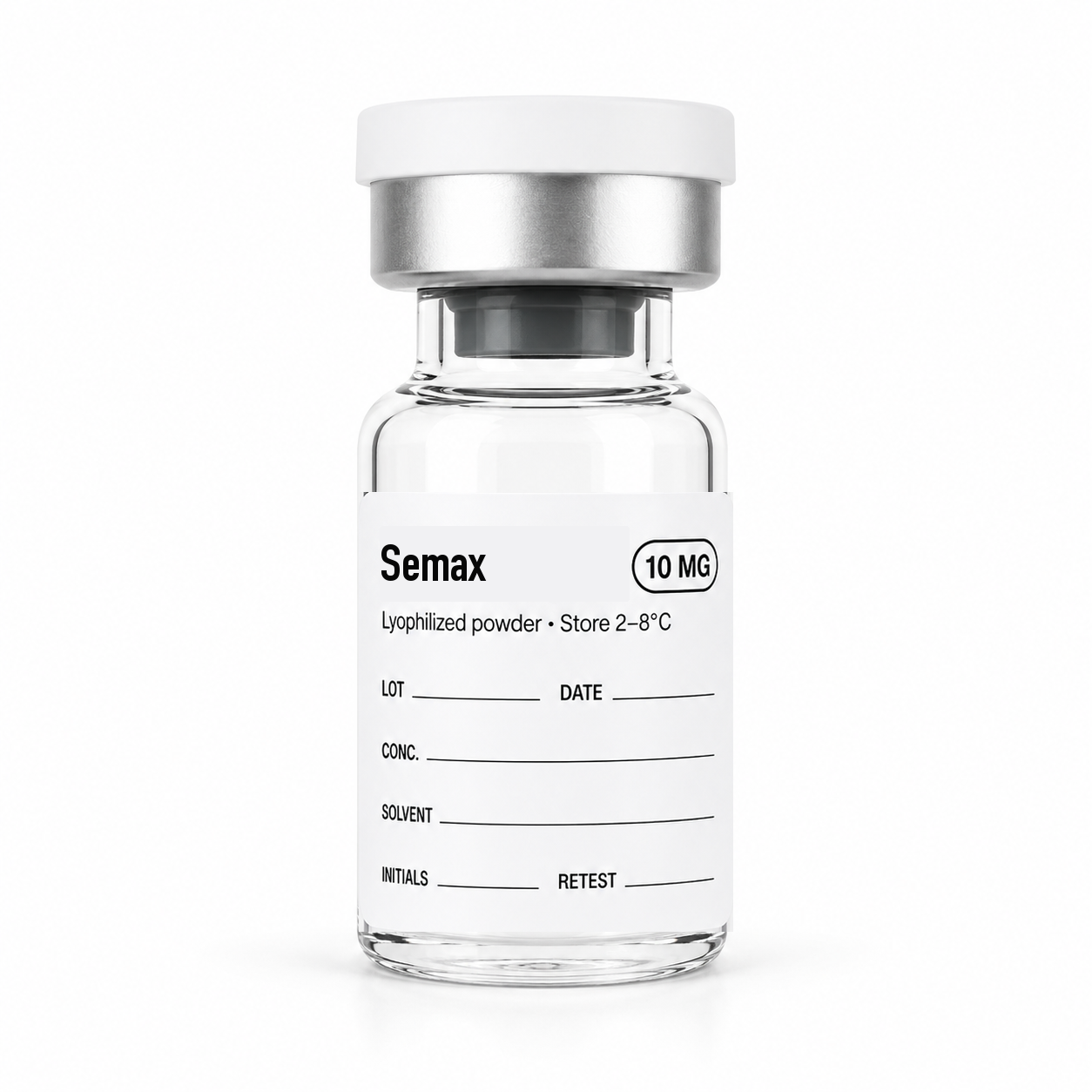
Quick Facts
Plain-English Summary
Semax is a synthetic seven-amino-acid peptide derived from ACTH(4-7), the cognitively active fragment of adrenocorticotropic hormone. Unlike ACTH itself, Semax does not stimulate the adrenal glands and produces no corticosteroid release at standard doses — the Pro-Gly-Pro C-terminal extension was added specifically to enhance metabolic stability and prolong CNS activity without the endocrine side effects of the parent hormone. The compound was developed at the Institute of Molecular Genetics in Moscow during the 1980s and was formally registered as a pharmaceutical drug in Russia in the mid-1990s.
The most consistently documented effect of Semax is upregulation of brain-derived neurotrophic factor (BDNF). This has been demonstrated across multiple rodent studies and, to a lesser extent, in human trial populations. BDNF plays a central role in neuronal survival, synaptic plasticity, and recovery following ischaemic injury, which forms the primary mechanistic rationale for Semax's approved indication in stroke rehabilitation. Russian clinical applications also include cognitive enhancement and optic nerve disease.
Delivery is primarily intranasal. The olfactory pathway allows the peptide to reach the CNS before it is degraded in plasma — the approximately 20-minute plasma half-life is too short to sustain meaningful systemic exposure by most other routes, which limits subcutaneous use. Sublingual delivery has been investigated as an alternative with moderate CNS penetration.
Semax vs. Selank — a common source of confusion. Both compounds are Russian-developed heptapeptides registered as drugs in Russia. Their profiles are distinct: Semax is primarily cognitive and neuroprotective, acting via BDNF and VEGF upregulation with meaningful human data in stroke and cognitive-deficit populations. Selank is primarily anxiolytic, modulating GABAergic and serotonin systems with its main clinical indication in generalised anxiety disorder. They are frequently combined — the Selank + Semax blend — but their mechanisms do not substantially overlap and they are not interchangeable for either indication.
Community claims describing Semax as a replacement for ADHD medications, a cure for brain damage, or a source of permanent cognitive enhancement overstate the evidence considerably. The available human data shows improvements in specific cognitive domains — attention, memory consolidation, processing speed — in defined populations (stroke survivors, patients with cognitive deficits). Whether these findings extend to healthy individuals seeking enhancement has not been tested in controlled trials.
The most significant limitation of the Semax evidence base is geographical: virtually all clinical data originates from Russian institutions, and independent replication in Western research environments has not been conducted. This is not evidence that the compound is ineffective, but it is a meaningful constraint on interpreting the available data. The Russian trial infrastructure, regulatory standards, and publication norms differ from FDA or EMA requirements, and full trial data is not always available in peer-reviewed English-language literature.
Mechanism of Action
Proposed mechanisms below are derived from in vitro and rodent studies only. No mechanistic pathway has been validated in a controlled human study.
All mechanistic data is derived from in vitro or rodent studies. Applicability of these pathways in humans is not established.
Animal Data
| Model | Finding | ICPS Status |
|---|---|---|
| Rat ischaemic stroke (MCAO) | Significant reduction in infarct volume and improved neurological deficit scores. VEGF and BDNF upregulation confirmed in peri-infarct tissue. Effect partially blocked by BDNF antibody, confirming pathway dependence. Filippenkov IB et al. ↗ | Preclinical |
| Rat spatial memory (Morris Water Maze) | Improved acquisition and retention of spatial memory tasks at 250–500 μg/kg intranasal doses. Hippocampal BDNF mRNA levels elevated at 24 h post-dosing. Umriukhin PE et al. ↗ | Preclinical |
| Rat chronic stress model | Attenuation of stress-induced BDNF decline in prefrontal cortex and hippocampus. Behavioural measures of attention and working memory preserved relative to untreated stressed controls. | Preclinical |
| Rat optic nerve injury | Partial preservation of retinal ganglion cell density and visual evoked potential amplitude following optic nerve crush. Consistent with Russian clinical application in optic nerve disease. | Preclinical |
| Rat gene expression (ischaemia, transcriptome) | Genome-wide transcriptomic analysis identified 84 differentially expressed genes in ischaemic brain following Semax administration, including neuroprotective and angiogenic clusters. Filippenkov IB et al. (stroke neuroprotection) ↗ | Preclinical |
No finding from this section has been replicated in a controlled human trial. Animal-to-human translation for peptides is uncertain and cannot be assumed.
Human Trials
| Trial | Population | Status | ICPS Status |
|---|---|---|---|
| Phase II/III — Acute Ischaemic Stroke Rehabilitation | Stroke patients; intranasal Semax initiated within 6 hours of onset; Russian multicentre trial | — | Russian Registration |
| Phase II — Cognitive Enhancement (Attention & Memory) | Patients with mild-to-moderate cognitive impairment; intranasal 0.1% solution, 7–14 days | — | Russian Registration |
| Optic Nerve Disease | Patients with optic neuritis and ischaemic optic neuropathy | — | Russian Registration |
| All non-Russian indications | — | — | No Western Data |
Semax has no FDA, EMA, or Health Canada–approved indications and no published Phase III trial data for any condition as of 2026.
Safety & Side Effects
Semax has been administered to thousands of patients in Russian clinical practice over approximately three decades. Serious adverse events are not prominently reported in available literature. The intranasal route avoids the injection-site risks of subcutaneous delivery and limits systemic exposure. No significant toxicity signals have emerged at registered therapeutic doses.
BDNF upregulation at high or chronic doses carries a theoretical concern in the context of BDNF's role in certain tumour growth and neuroplasticity processes. VEGF induction raises similar theoretical pro-angiogenic considerations in individuals with undetected malignancy. No human data quantifies these risks for Semax specifically.
- Transient nasal irritation with intranasal use
- Mild headache during initial dosing period
- Heightened alertness, occasionally unwanted
- Irritability or restlessness at higher doses
- No formal pharmacovigilance database exists outside Russia
- Active or suspected malignancy
- Pregnancy or breastfeeding
- Seizure disorders (BDNF modulation and excitability)
- Concurrent MAOI or serotonergic drug use
- Children and adolescents
Semax is not approved by the FDA, EMA, or Health Canada for any medical indication. It is classified as a research compound and is not legal for human therapeutic use in most jurisdictions. Procurement and use outside of registered clinical trials carries regulatory and unknown health risks.
References
Research disclaimer. CompoundProfile publishes summaries of available scientific literature for educational purposes only. This page does not constitute medical advice and should not be interpreted as an endorsement of Semax for any therapeutic use. Consult a licensed healthcare professional before considering any research compound. All evidence gradings reflect the state of published literature as of September 2026 and are assessed independently by ICPS.
Community Commentary
Selected discussion from r/Peptides · Curated for signal, not volume
The thing that makes Semax's profile genuinely interesting — and often misrepresented — is that it has real human trial data, which very few research peptides can claim. Russian Phase II/III data is not the same as FDA Phase III data, but it's not nothing either. The BDNF mechanism is solid, the stroke data is plausible. The issue is that the 'cognitive enhancer in healthy people' claim is pure extrapolation. Every study was in impaired populations. BDNF in a damaged brain and BDNF in a healthy brain aren't doing the same thing.
Exactly this. The community has a habit of reverse-engineering a claim from mechanism: BDNF is good for cognition → Semax raises BDNF → Semax improves cognition. That's not how clinical evidence works. Healthy-population data simply does not exist.
The intranasal delivery story is probably the most underappreciated part of Semax's pharmacology. The 20-minute plasma half-life sounds like a liability but it's actually the point — the peptide reaches CNS via the olfactory pathway before systemic degradation becomes limiting. The olfactory-to-brain route is anatomically real and has been demonstrated for several neuropeptides. That said, CNS bioavailability fractions via this route are hard to measure in humans and the community dose estimates are mostly extrapolated from Russian clinical vials, not from PK studies.
People constantly conflate Selank and Semax because they're both Russian heptapeptides sold in nasal spray form and often blended. They're meaningfully different. Selank is anxiolytic — GABAergic, serotonin modulation, its primary clinical use is anxiety. Semax is cognitive and neuroprotective — BDNF, VEGF, ischaemia recovery. The overlap in the blend makes marketing sense but creates real confusion about what mechanism you're actually targeting. If you're treating anxiety symptoms, Selank is the relevant profile. Semax is doing something else.
Agreed. The blend makes sense if you want both anxiolytic and cognitive effects simultaneously, but you need to understand you're getting two distinct pharmacological profiles, not one compound doing double duty.
Frustrating that this hasn't attracted Western trial interest given the stroke data. The acute window is well-defined, the mechanism via VEGF is plausible, and the Russian results are consistent across multiple publications. But Russian pharma doesn't have the resources or incentive to run FDA-compliant trials, and Western institutions haven't picked it up. That gap isn't evidence of failure — it's a funding and jurisdictional gap. Worth keeping in mind when reading commentary that treats 'no Western trials' as equivalent to 'doesn't work.'