Quick Facts
Plain-English Summary
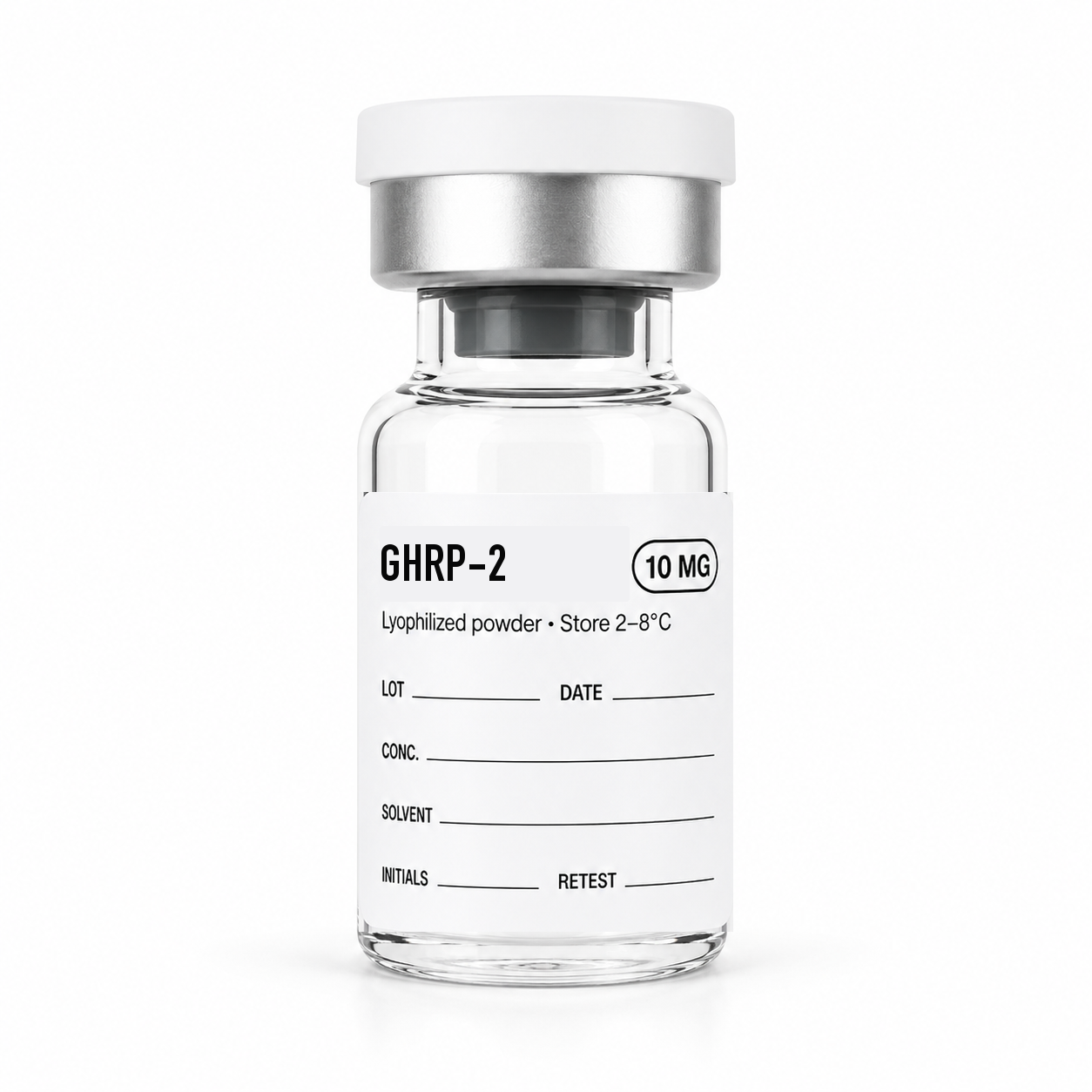
GHRP-2 (Growth Hormone Releasing Peptide-2), marketed briefly as Pralmorelin in Japan, is a fully synthetic six-amino-acid peptide engineered to mimic ghrelin — the endogenous "hunger hormone" — and stimulate pulsatile growth hormone release from the anterior pituitary. It was developed by Cyril Y. Bowers and colleagues at Tulane University as part of a systematic effort to identify potent, orally or parenterally active GH secretagogues beginning in the 1980s. GHRP-2 emerged as one of the most potent compounds in its class, producing GH pulses 2 to 4 times greater than GHRP-6 at equivalent doses in controlled human studies.
Unlike endogenous ghrelin, GHRP-2 does not carry an acyl modification and was specifically designed for metabolic stability and receptor specificity. Its primary target is GHS-R1a (growth hormone secretagogue receptor type 1a), a G-protein coupled receptor expressed in the pituitary, hypothalamus, and peripheral tissues. Activation of GHS-R1a by GHRP-2 triggers a robust, dose-dependent GH pulse — but also stimulates release of cortisol, ACTH, and prolactin, which distinguishes it from more selective agents such as Ipamorelin.
GHRP-2 has a substantially larger human evidence base than most peptides in the research compound space. Multiple Phase I and Phase II studies were conducted across the 1990s and 2000s, examining its effects on GH secretion, body composition, and utility as a diagnostic tool for GH axis integrity. The compound received regulatory approval in Japan under the name Pralmorelin specifically as a GH stimulation test agent — making it one of the very few GHRPs to have achieved any form of regulatory approval.
GHRP-2's elevation of cortisol and prolactin alongside GH is a clinically meaningful distinction. Community discussions that focus exclusively on GH output while omitting the cortisol response present an incomplete picture of the compound's endocrine effects.
As of 2026, GHRP-2 is not approved by the FDA, EMA, or Health Canada for any therapeutic indication. The Japanese Pralmorelin approval covers only diagnostic GH stimulation testing — not therapeutic GH replacement or body composition modification. The anabolic and anti-aging claims circulating in research compound communities are not supported by the published clinical evidence base.
Mechanism of Action
Proposed mechanisms below are derived from in vitro and rodent studies only. No mechanistic pathway has been validated in a controlled human study.
All mechanistic data is derived from in vitro or rodent studies. Applicability of these pathways in humans is not established.
Animal Data
| Model | Finding | ICPS Status |
|---|---|---|
| Rat pituitary — GH secretion | Dose-dependent GH release at nanomolar concentrations. Effect blocked by GHS-R1a antagonist, confirming receptor-mediated mechanism. Bowers et al. 1984 ↗ | Preclinical |
| Rat GH pulse amplitude | GHRP-2 produced 2–4x greater peak GH vs. GHRP-6 at equivalent molar doses. Both agents were substantially amplified by co-administration with GHRH. Arvat et al. 1993 ↗ | Preclinical |
| Aged rat — somatotropic axis | GHRP-2 partially restored pulsatile GH secretion in aged animals where spontaneous GH release was attenuated. Effect correlated with GHS-R1a receptor density, which declines with age. | Preclinical |
| Rat — GHRH synergy | Combined GHRP-2 + GHRH produced 5–10x GH area-under-curve vs. either compound alone. Somatostatin suppression was identified as the primary mechanism of synergy. Ghigo et al. 1994 ↗ | Preclinical |
| Rat — cortisol / ACTH | ACTH and corticosterone elevated in parallel with GH pulse. Effect dose-dependent and receptor-mediated — not observed with Ipamorelin at comparable doses, confirming GHRP-2's broader receptor footprint. | Preclinical |
| Chronic administration — desensitisation | Repeated daily dosing resulted in attenuated GH response over 2–4 weeks in rodent models. Pulse magnitude decreased by 30–50% at 4-week mark, suggesting receptor downregulation or somatostatin rebound with chronic use. | Preclinical |
No finding from this section has been replicated in a controlled human trial. Animal-to-human translation for peptides is uncertain and cannot be assumed.
Human Trials
| Trial | Population | Status | ICPS Status |
|---|---|---|---|
| Phase I — GH stimulation kinetics | Healthy male volunteers; single IV and SC doses 0.1–3 μg/kg. Measured GH, cortisol, ACTH, prolactin time-course. | — | Published |
| Phase I — GHRP-2 vs. GHRP-6 comparison | Healthy adults, crossover design. Equivalent molar doses of GHRP-2 and GHRP-6 administered SC. | — | Published |
| Phase I — GHRP-2 + GHRH synergy | Healthy adults and GH-deficient patients. GHRP-2 alone, GHRH alone, and combination administered IV. | — | Published |
| Phase II — Pralmorelin GH stimulation test (Japan) | Patients with suspected GH deficiency, paediatric and adult cohorts. 100 μg IV Pralmorelin (GHRP-2) as diagnostic GH stimulation test. | — | Regulatory Approved |
| All body composition / anabolic indications | — | — | No Data |
GHRP-2 has no FDA, EMA, or Health Canada–approved indications and no published Phase III trial data for any condition as of 2026.
Safety & Side Effects
Every controlled human study of GHRP-2 has documented concurrent elevation of cortisol, ACTH, and prolactin alongside the GH pulse. These are on-target receptor effects, not incidental adverse events. Chronic cortisol elevation carries risks of insulin resistance, immune suppression, and hypothalamic-pituitary-adrenal axis dysregulation. Duration and magnitude of these effects with chronic self-administration are unknown.
GHS-R1a agonism activates orexigenic (appetite-stimulating) signalling pathways. GHRP-2 produces less pronounced hunger than GHRP-6, but increased appetite and caloric intake have been documented in controlled settings. Individuals using GHRP-2 for body composition purposes may inadvertently increase caloric intake, offsetting intended lean-mass effects.
- GH pulse amplitude attenuates with daily dosing over weeks
- Receptor downregulation observed in chronic preclinical models
- Cycling protocols commonly used in research community — no validated human data
- Recovery timeline after chronic use not characterised in human studies
- Somatostatin rebound may further blunt endogenous GH pulsatility
- Active or suspected malignancy (GH and IGF-1 elevation may accelerate tumour growth)
- Diabetes or insulin resistance (cortisol elevation worsens glycaemic control)
- Prolactin-sensitive conditions (gynaecomastia risk)
- Pregnancy or breastfeeding
- HPA axis disorders or active corticosteroid therapy
- Children and adolescents outside clinical supervision
GHRP-2 is not approved by the FDA, EMA, or Health Canada for any medical indication. It is classified as a research compound and is not legal for human therapeutic use in most jurisdictions. Procurement and use outside of registered clinical trials carries regulatory and unknown health risks.
References
Research disclaimer. CompoundProfile publishes summaries of available scientific literature for educational purposes only. This page does not constitute medical advice and should not be interpreted as an endorsement of GHRP-2 for any therapeutic use. Consult a licensed healthcare professional before considering any research compound. All evidence gradings reflect the state of published literature as of September 2026 and are assessed independently by ICPS.
Community Commentary
Selected discussion from r/Peptides · Curated for signal, not volume
The cortisol piece is the thing nobody wants to talk about. Every published GHRP-2 study — Arvat's group, Ghigo's group, the Japanese Pralmorelin work — documents concurrent ACTH and cortisol elevation alongside the GH pulse. It's not a side effect in the traditional sense; it's on-target GHS-R1a activation in the corticotrophs and adrenal cortex. People running GHRP-2 for months and wondering why their sleep quality is off, their recovery isn't improving, or their glycaemic control is shifting — cortisol chronically elevated is a real candidate explanation.
This is why Ipamorelin gets recommended as the "cleaner" option. It hits GHS-R1a with high selectivity and doesn't appreciably move cortisol or prolactin at standard doses. The GH pulse is somewhat smaller but the endocrine footprint is narrower. GHRP-2 is a more potent GH secretagogue, but potency and safety profile are separate questions. If someone specifically wants maximum GH output and understands the cortisol trade-off, that's a different conversation than recommending it as a general-purpose GH peptide.
The GHRH combination data is probably the most practically interesting part of GHRP-2's pharmacology. Bowers' original papers and the Arvat group's follow-up work both show 5–10x GH area-under-curve when you combine a GHRP with a GHRH analogue. The mechanism is straightforward: GHRP-2 reduces somatostatin tone, GHRH directly stimulates somatotrophs — you're hitting two independent nodes in the same pathway. Neither agent at standard doses gets you anywhere close to what the combination produces. That's why CJC-1295 + Ipamorelin or CJC + GHRP-2 combos dominate community protocols. The synergy is real and is documented in human PK studies.
Worth contextualising what the Pralmorelin approval in Japan actually means. It's a diagnostic approval — 100 μg IV, single administration, to test GH axis integrity in patients with suspected GH deficiency. It's not a therapeutic approval. The test is analogous to an insulin tolerance test but with better tolerability. The fact that it got any regulatory approval at all is meaningful for evidence quality, but people citing "it was approved in Japan" to justify chronic subcutaneous self-administration for muscle gain are misrepresenting what that approval covers.
Exactly. "Regulatory approval" and "approved for this use" are different things. The Japanese PMDA data package for Pralmorelin is built around single-dose IV kinetics in a clinical setting. There is zero chronic dosing safety data from that approval pathway. It's actually one of the more honest examples in this space — the compound has real human data, but for a very specific indication that bears almost no resemblance to how it's used in research communities.
Chronic use desensitisation is something that's documented in animal models and widely acknowledged in community experience but almost never gets quantified seriously. The rodent data suggests a 30–50% attenuation in GH pulse magnitude after 3–4 weeks of daily dosing. The community norm of running 8–12 week cycles and then taking breaks is almost certainly responding to a real biological phenomenon — but the optimal cycle length, recovery period, and whether HPA axis recovery tracks GH axis recovery are all genuinely unknown. We're working with preclinical data and anecdotal cycling norms where we should have proper human PK/PD data.