Quick Facts
Plain-English Summary
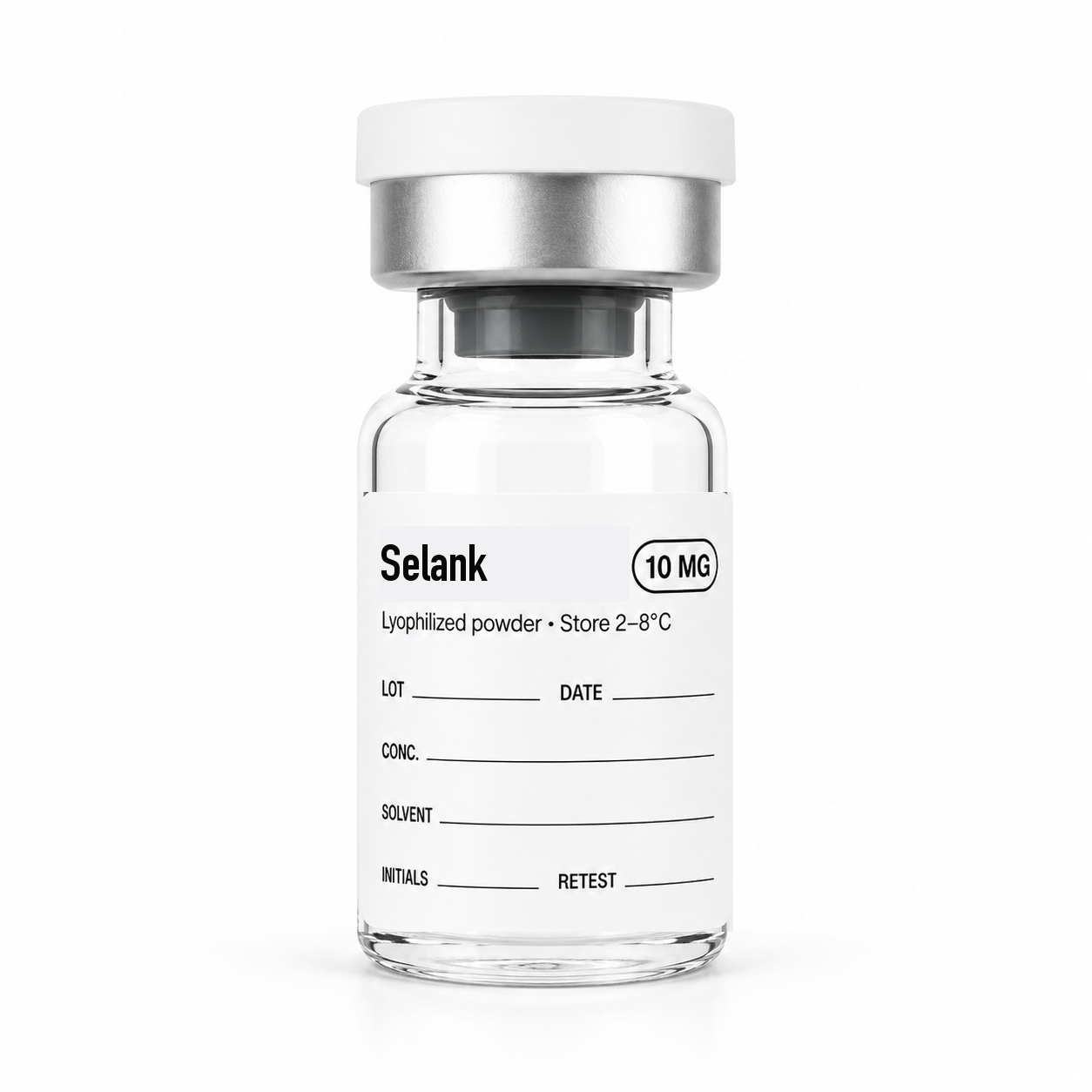
Selank is a synthetic heptapeptide developed in the 1990s at the Institute of Molecular Genetics in Moscow under the direction of researchers including Kozlovskaya MM and Dronova TA. It was engineered as a stable analogue of tuftsin — an endogenous tetrapeptide (Thr-Lys-Pro-Arg) produced by the spleen with known immunomodulatory properties. The problem with native tuftsin is its extremely short half-life in plasma (seconds to minutes). The researchers appended a Pro-Gly-Pro tripeptide to the C-terminus, producing a compound with a measurably longer, though still brief, plasma half-life of approximately 2–3 minutes. This short systemic half-life necessitated the intranasal delivery route used in Russian clinical practice, where absorption through the nasal mucosa is thought to allow direct or rapid CNS access.
Selank holds an unusual position in the global research landscape: it is among a small set of peptides that have progressed to registered pharmaceutical status in Russia while remaining almost entirely absent from Western peer-reviewed clinical trial registries. This creates an evidence asymmetry that is important to understand. The compound has real clinical data behind it — it is not purely experimental — but that data was generated within a Russian research system, is predominantly published in Russian-language journals, and has not been independently replicated by Western institutions. Evaluating Selank requires grappling honestly with that limitation.
The primary clinical findings from Russian trials concern anxiety reduction. In studies involving patients with generalised anxiety disorder (GAD), Selank administered as nasal drops produced anxiolytic effects broadly comparable to low-dose medazepam (a benzodiazepine), without producing sedation or signs of tolerance or dependence over trial durations of two to four weeks. Additional Russian research has documented improvements in cognitive measures — attention, memory consolidation, and information processing — in both healthy volunteers and clinical populations.
The Russian regulatory approval is meaningful context but does not substitute for the independent replication standard expected by FDA, EMA, or Health Canada. The language barrier limits accessibility of the primary literature, and the trial populations, designs, and outcome measures used in Russian studies may not map directly onto Western diagnostic frameworks.
Community interest in Selank has grown considerably in nootropic and biohacking circles, largely driven by its proposed anxiolytic effects without the sedation and dependence liabilities of benzodiazepines. These claims rest on real, if limited and geographically concentrated, clinical evidence — a situation that makes Selank substantially better-supported than many compounds in this space, while still falling well short of the evidence standards that would satisfy Western regulators or most clinical practitioners.
Mechanism of Action
Proposed mechanisms below are derived from in vitro and rodent studies only. No mechanistic pathway has been validated in a controlled human study.
All mechanistic data is derived from in vitro or rodent studies. Applicability of these pathways in humans is not established.
Animal Data
| Model | Finding | ICPS Status |
|---|---|---|
| Rat anxiety models (elevated plus maze, open field) | Significant anxiolytic effects at doses of 100–300 μg/kg. Effect comparable to diazepam at standard doses but without observed sedation or ataxia at anxiolytic doses. Replicated across multiple Soviet/Russian research groups. | Preclinical |
| Rat memory and learning (Morris water maze) | Improved spatial memory consolidation and recall with repeated administration. Memory-enhancing effects were observed to persist for a period after compound clearance, consistent with BDNF-mediated synaptic consolidation. | Preclinical |
| Rat opiate withdrawal model | Attenuated behavioural signs of morphine withdrawal. Proposed mechanism: enkephalin system modulation extending endogenous opioid peptide activity. Cited as support for Russian clinical use in withdrawal management. | Preclinical |
| Rat immune modulation | Normalised cytokine profiles (IL-6, IL-1β, interferon-gamma) in stress-induced immunosuppression models. Enhanced phagocytic activity of macrophages and neutrophils, consistent with parent compound tuftsin's known mechanism. | Preclinical |
| Rat stress-induced cognitive impairment | Protected against acute and chronic stress-induced deficits in attention and working memory tasks. Proposed mechanism: combined GABAergic anxiolysis and BDNF-mediated neuroprotection reducing stress-induced hippocampal impact. | Preclinical |
No finding from this section has been replicated in a controlled human trial. Animal-to-human translation for peptides is uncertain and cannot be assumed.
Human Trials
| Trial | Population | Status | ICPS Status |
|---|---|---|---|
| GAD Randomised Trial (Selezneva ND et al.) | Patients with generalised anxiety disorder (DSM equivalent). Selank nasal drops vs. medazepam (benzodiazepine). Russian-language publication; trial design and blinding not independently verified. | — | Russian RCT |
| Alcohol Withdrawal Pilot (Kozlovskaya MM & Dronova TA) | Small pilot study in alcohol-dependent patients during supervised withdrawal. Intranasal Selank adjunct to standard care. | — | Pilot Only |
| BDNF Upregulation Study (Uchakina ON et al.) | Human subjects receiving intranasal Selank; serum and CSF BDNF levels measured pre- and post-administration. | — | Mechanistic |
| All other indications | — | — | No Western Data |
Selank has no FDA, EMA, or Health Canada–approved indications and no published Phase III trial data for any condition as of 2026.
Safety & Side Effects
Russian clinical trials reported no serious adverse events in GAD and withdrawal populations across trial durations of 2–4 weeks. No signs of dependence, tolerance, or rebound anxiety observed at trial end. No sedation at anxiolytic doses — a key distinguishing finding vs. benzodiazepines. The compound's short plasma half-life limits systemic accumulation risk.
Long-term effects of repeated GABA-A modulation and BDNF upregulation are uncharacterised beyond Russian trial durations. Chronic immunomodulatory effects of the tuftsin-derived component are not defined in human populations. Interaction data with psychoactive medications (benzodiazepines, SSRIs, opioids) is absent.
- Mild nasal irritation or burning with intranasal dosing
- Transient headache during initial use period
- Mild fatigue or sedation at higher doses (not observed in clinical trials)
- Occasional cognitive fogginess during adjustment period
- No pharmacovigilance database exists for Selank outside Russian systems
- Current benzodiazepine or opioid therapy (interaction risk uncharacterised)
- Active psychiatric conditions managed by a clinician without disclosure
- Pregnancy or breastfeeding
- Active autoimmune conditions (immunomodulatory effects uncontrolled)
- Children and adolescents
Selank is not approved by the FDA, EMA, or Health Canada for any medical indication. It is classified as a research compound and is not legal for human therapeutic use in most jurisdictions. Procurement and use outside of registered clinical trials carries regulatory and unknown health risks.
References
Research disclaimer. CompoundProfile publishes summaries of available scientific literature for educational purposes only. This page does not constitute medical advice and should not be interpreted as an endorsement of Selank for any therapeutic use. Consult a licensed healthcare professional before considering any research compound. All evidence gradings reflect the state of published literature as of September 2026 and are assessed independently by ICPS.
Community Commentary
Selected discussion from r/Peptides · Curated for signal, not volume
What distinguishes Selank mechanistically from benzodiazepines isn't just "different binding site" — it's that the evidence suggests positive modulation of GABA-A activity without the receptor downregulation that drives tolerance. Benzodiazepines cause receptor internalisation with chronic use; there's no published evidence of this with Selank. Whether that translates to clinical non-dependence is exactly what the Russian trials show, though the trial durations (2–4 weeks) are short enough that you can't extrapolate to long-term use with any confidence.
This is the part that gets lost in community discussions. People read "no withdrawal in trials" and treat it as proof of non-dependence potential. The trials are 2–4 weeks. Benzodiazepine dependence at therapeutic doses typically manifests after months of use. The absence of a signal at 4 weeks is genuinely reassuring but it's not a clean bill of health for long-term use.
Speaking as someone who reads Russian: the language barrier problem with Selank is worse than people acknowledge. Even when titles are translated, the full methods sections of the Russian trials are essentially inaccessible to Western reviewers. I've read several of the primary Selezneva and Kozlovskaya papers in Russian and the trial designs are real — randomised, controlled, with recognisable diagnostic criteria — but the blinding quality and randomisation procedures are described in ways that wouldn't survive modern CONSORT-standard scrutiny. That doesn't mean the results are wrong. It means we can't verify them the way we can verify a NEJM paper.
The Uchakina BDNF data is the most interesting piece of this profile to me. If Selank genuinely upregulates BDNF in humans in a meaningful way, that's actually a credible nootropic mechanism — BDNF drives long-term potentiation and is depleted by chronic stress. An anxiolytic that simultaneously increased BDNF would be pharmacologically interesting in a way that's actually coherent. The problem is the study is small, hasn't been replicated, and the magnitude of BDNF increase and its functional significance aren't clearly characterised.
Worth noting that SSRIs are known to upregulate BDNF too — that's one of the main proposed mechanisms behind their antidepressant effect. If Selank reliably does this via a different route, that's a legitimately interesting pharmacological finding. But "interesting" and "clinically useful" are separated by years of development that hasn't happened outside Russia.
The intranasal route matters more than people realise. With a 2–3 minute plasma half-life, subcutaneous injection is arguably pointless — you'd be fighting systemic degradation constantly. The Russian nasal drops formulation was specifically designed around this pharmacokinetic reality. What I don't see discussed enough is that even intranasal delivery doesn't guarantee CNS entry for a peptide this size. The nasal mucosa pathway to the brain is real but the fraction of administered dose that actually reaches the CNS via olfactory transport is not well quantified for Selank specifically. The Russian trials show a clinical effect — but the delivery mechanism is less clean than is often assumed.