Quick Facts
Plain-English Summary
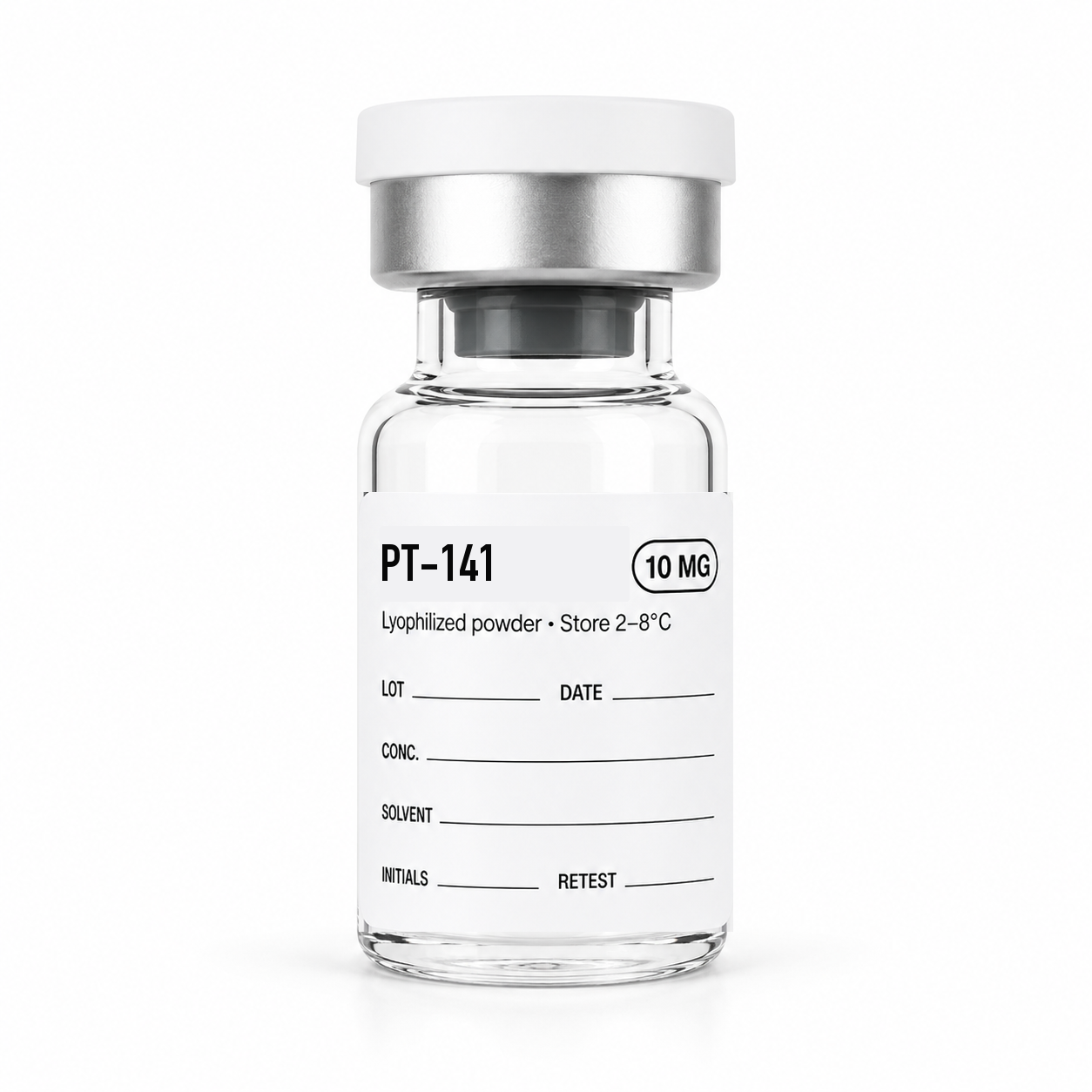
PT-141 (bremelanotide) is a synthetic cyclic heptapeptide developed by Palatin Technologies as a modified analogue of Melanotan II (MT-II). MT-II is itself a synthetic analogue of alpha-melanocyte-stimulating hormone (α-MSH), a naturally occurring neuropeptide that binds melanocortin receptors throughout the brain and periphery. The key structural difference between PT-141 and MT-II is the absence of an N-terminal amide group and the free C-terminal carboxyl group in PT-141 — a modification that dramatically reduces activity at MC1R (the receptor responsible for tanning and pigmentation) while preserving potent agonism at MC3R and MC4R, the receptors principally involved in sexual motivation and energy homeostasis.
In June 2019, the FDA approved bremelanotide injection (Vyleesi®, AMAG Pharmaceuticals) for the treatment of acquired, generalised Hypoactive Sexual Desire Disorder (HSDD) in premenopausal women. This made PT-141 the first centrally-acting pharmacotherapy approved for female sexual dysfunction in the United States, and the second approved treatment for HSDD overall (after flibanserin/Addyi, approved 2015). The approval was based on two pivotal Phase III randomised, double-blind, placebo-controlled RECONNECT studies, which demonstrated statistically significant improvements in satisfying sexual events and desire scores versus placebo over 24 weeks.
FDA Approval context: Vyleesi is approved specifically for acquired, generalised HSDD in premenopausal women — not for situational low desire, postmenopausal women, men, or general sexual enhancement. Compounded PT-141 distributed outside this context is off-label use.
Off-label use in males for erectile dysfunction (ED) and sexual desire has become common in the compounding market. Phase II clinical data in males does exist and showed promising results for both psychogenic and organic ED — however, no Phase III trial has been completed for a male indication, and PT-141 is not approved for erectile dysfunction. The mechanism in males likely involves the same central melanocortin pathway rather than the peripheral vasodilation mechanism of PDE5 inhibitors (sildenafil, tadalafil), which means PT-141 and PDE5 inhibitors have distinct and potentially complementary modes of action.
The most commonly reported adverse effect is nausea, occurring in approximately 40% of subjects in Phase III trials. A transient increase in blood pressure — peaking around 30 minutes post-injection and typically resolving within 12 hours — was also observed and is listed as a label warning. These side effects distinguish PT-141 meaningfully from PDE5 inhibitors and represent the primary tolerability constraint in clinical practice.
Mechanism of Action
Proposed mechanisms below are derived from in vitro and rodent studies only. No mechanistic pathway has been validated in a controlled human study.
All mechanistic data is derived from in vitro or rodent studies. Applicability of these pathways in humans is not established.
Animal Data
| Model | Finding | ICPS Status |
|---|---|---|
| Rat — male sexual behaviour (Pfaus et al.) | Subcutaneous α-MSH analogues (including PT-141 precursors) significantly increased mount frequency, intromission rate, and ejaculation in sexually sluggish male rats. MC4R agonism identified as the key receptor subtype mediating pro-erectile effects. Pfaus JG et al. 2004 ↗ | Preclinical |
| Female rat — lordosis and solicitation | MC4R agonists increased proceptive behaviours (ear wiggling, darting, hopping) and lordosis quotient in ovariectomised female rats not responsive to hormone replacement alone. Suggests central melanocortin pathway involvement in female desire independent of oestrogen. Pfaus JG et al. 2004 ↗ | Preclinical |
| MC4R knockout mouse | MC4R-null mice showed markedly reduced copulatory behaviour versus wild type, confirming MC4R as required for normal sexual motivation. PT-141 was ineffective in knockout mice, establishing receptor-specificity of action. Pharmacological validation of the target mechanism. | Preclinical |
| Rabbit — penile erection model | Direct intracerebroventricular injection of MT-II and PT-141 analogues elicited penile erections and yawning in anaesthetised rabbits, consistent with central (not peripheral) initiation of erection via the melanocortin system. | Preclinical |
| Cardiovascular — blood pressure (rat) | Transient dose-dependent elevation in mean arterial pressure observed after systemic administration. Effect peaks ~20–30 min post-dose, resolves within several hours. Mechanism: MC4R-mediated central sympathetic activation. Reproduced in Phase II/III human trials. | Preclinical |
No finding from this section has been replicated in a controlled human trial. Animal-to-human translation for peptides is uncertain and cannot be assumed.
Human Trials
| Trial | Population | Status | ICPS Status |
|---|---|---|---|
| RECONNECT Study 1 — Phase III (Clayton AH et al.) | n=394 premenopausal women with acquired, generalised HSDD; 1.75 mg SC on-demand vs placebo; 24 weeks | — | Phase III — Met Endpoints |
| RECONNECT Study 2 — Phase III (Simon JA et al.) | n=395 premenopausal women with HSDD; same design as Study 1; independently powered | — | Phase III — Met Endpoints |
| FDA Approval — Vyleesi® (June 2019) | Approved for acquired, generalised HSDD in premenopausal women based on RECONNECT programme | — | FDA Approved |
| Phase II — Male Erectile Dysfunction (Diamond LE et al.) | n=65 men with psychogenic or organic ED; subcutaneous bremelanotide 4 mg vs placebo | — | Phase II — Males (Unapproved) |
| Intranasal formulation (discontinued) | Phase II trials explored intranasal PT-141; development halted following blood pressure elevation concerns at effective nasal doses | — | Discontinued |
PT-141 has no FDA, EMA, or Health Canada–approved indications and no published Phase III trial data for any condition as of 2026.
Safety & Side Effects
Nausea is the most frequently reported adverse effect, occurring in approximately 40% of subjects receiving bremelanotide in Phase III trials versus ~1% with placebo. Nausea typically begins within 30–60 minutes of injection and resolves within a few hours. FDA labelling recommends that women experiencing severe nausea use an antiemetic prior to dosing. Nausea was the primary reason for treatment discontinuation in trials.
A transient mean arterial pressure increase of approximately 2–4 mmHg has been observed post-dose. Peak effect occurs around 30 minutes after injection; blood pressure returns to baseline within approximately 12 hours. The FDA label contraindicates use in patients with known cardiovascular disease or uncontrolled hypertension. This effect is centrally mediated via MC4R-driven sympathetic activation and distinguishes PT-141 from PDE5 inhibitors.
- Flushing and facial warmth (~20% in Phase III)
- Headache (~11%)
- Injection site haematoma or bruising
- Fatigue or somnolence in first hours post-dose
- Focal hyperpigmentation with long-term use (case reports; mechanism: residual low-level MC1R activity at higher cumulative doses)
- Yawning and stretching (predictable MC4R-mediated effect; also seen in animal models)
- Uncontrolled hypertension or known cardiovascular disease
- Pregnancy or breastfeeding (no safety data)
- History of hyperpigmentation disorders
- Concurrent antihypertensive therapy (potentiation risk)
- Males — not an approved indication; risk-benefit evaluation required
- Postmenopausal women — outside approved indication; limited data
- Children and adolescents
PT-141 is not approved by the FDA, EMA, or Health Canada for any medical indication. It is classified as a research compound and is not legal for human therapeutic use in most jurisdictions. Procurement and use outside of registered clinical trials carries regulatory and unknown health risks.
References
Research disclaimer. CompoundProfile publishes summaries of available scientific literature for educational purposes only. This page does not constitute medical advice and should not be interpreted as an endorsement of PT-141 for any therapeutic use. Consult a licensed healthcare professional before considering any research compound. All evidence gradings reflect the state of published literature as of September 2026 and are assessed independently by ICPS.
Community Commentary
Selected discussion from r/Peptides · Curated for signal, not volume
The distinction between PT-141 and MT-II is frequently hand-waved past in vendor descriptions. MT-II is a pan-melanocortin agonist — MC1R activity means tan, MC3R/MC4R activity means appetite suppression and sexual arousal, MC2R is ACTH pathway. PT-141's structural modification reduces MC1R affinity without eliminating it entirely — you can still see focal hyperpigmentation with prolonged use, which the label notes. The claim that PT-141 "has no pigmentation effect" is technically imprecise; it's more accurate to say the effect is substantially reduced versus MT-II.
Correct. The pharmacology here is cleaner than MT-II for sexual applications but it's not a perfect separation. The nausea profile likely traces to MC3R activity as well as central 5-HT modulation. The cardiovascular BP spike is well-established and the mechanism (central sympathetic activation via hypothalamic MC4R) is coherent. If you have any hypertension, this is not a compound to mess with off-label.
Something I rarely see discussed properly: Vyleesi is the only FDA-approved option for HSDD in women that works on-demand rather than requiring daily dosing (flibanserin/Addyi is taken nightly). That's a genuinely meaningful clinical differentiator for patients who don't want to commit to a daily regimen. The RECONNECT data is real, the effect size is modest but statistically robust, and the approval is legitimate. The problem is that the compounding market has stripped all context from this and markets PT-141 as a general "sex peptide" for everyone — which is not what the clinical programme showed.
For males specifically: the Diamond et al. Phase II data is legitimate and interesting — significant improvement in erectile function across both psychogenic and organic subtypes, at 4 mg SC (which is a higher dose than the approved female dose of 1.75 mg). But no Phase III was completed for males. The reason is likely commercial — Palatin and AMAG chose to pursue the female HSDD market, not because the male data was negative. The compounding community has run with this and assumes equivalence that the regulatory record doesn't support. Worth knowing.
Right — the absence of a Phase III for males reflects a business decision more than a scientific signal. The mechanism is plausible, the Phase II results are positive, but "plausible mechanism + Phase II" is a different standard than what supported the FDA approval. Regulatorily, it's night and day.
People consistently underestimate the nausea. 40% incidence in a controlled trial is not a minor footnote — that's a clinically significant tolerability problem, especially in an on-demand sexual health context. The FDA label addresses it because it was a real barrier to adherence in RECONNECT. Vendors who describe PT-141 as a smooth, side-effect-free compound are either not reading the literature or actively misleading buyers. The BP spike alone warrants a proper cardiovascular history before anyone with hypertension considers this.