Quick Facts
Plain-English Summary
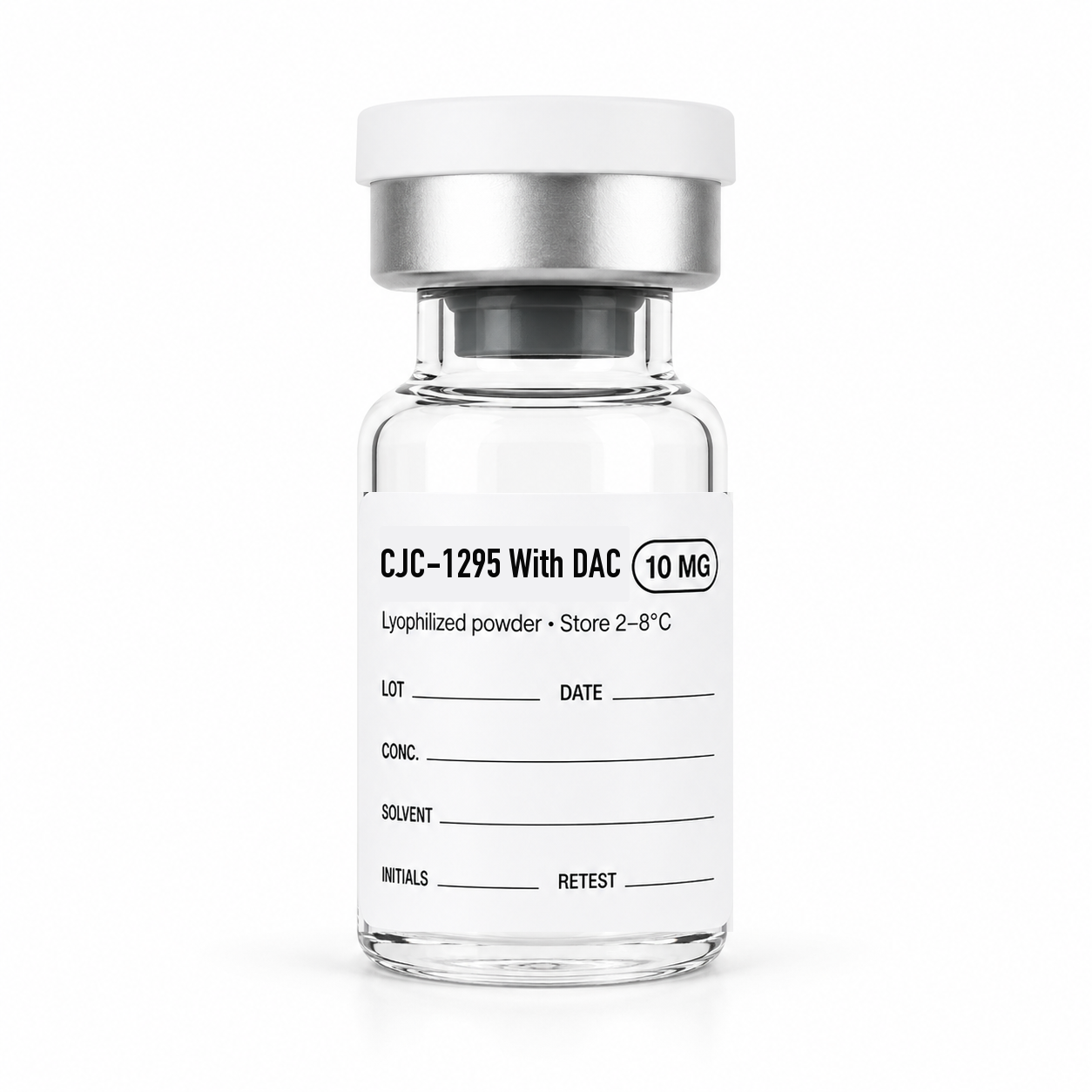
CJC-1295 with DAC is a modified GHRH analogue that incorporates a Drug Affinity Complex — a maleimidoproprionic acid (MPA) moiety that covalently binds to serum albumin following injection. This albumin binding dramatically extends the compound's half-life from ~30 minutes (without DAC) to approximately 6–8 days, allowing once or twice weekly dosing.
A published phase II human trial demonstrated dose-dependent GH and IGF-1 elevation persisting for up to 14 days. The long-acting profile is both its primary clinical advantage (convenience, sustained IGF-1 elevation) and its primary pharmacological concern (non-physiological continuous GHRH stimulation, potential tachyphylaxis).
The convenience of weekly dosing comes with an important pharmacological trade-off: continuous GHRH receptor stimulation is not the same as the natural pulsatile pattern. The long-term implications of sustained, non-pulsatile GH axis activation in healthy adults remain poorly characterised.
Mechanism of Action
Proposed mechanisms below are derived from in vitro and rodent studies only. No mechanistic pathway has been validated in a controlled human study.
All mechanistic data is derived from in vitro or rodent studies. Applicability of these pathways in humans is not established.
Animal Data
| Model | Finding | ICPS Status |
|---|---|---|
| Rat — GH/IGF-1 elevation | Single administration produced sustained GH and IGF-1 elevation over multiple days, tracking closely with human pharmacodynamic findings in the Teichman trial. Dose-dependent response confirmed. | Preclinical |
| Rodent — lean mass and bone density | Studies in rats demonstrate anabolic effects on lean mass and bone mineral density with repeated CJC-1295 DAC administration. Effect magnitude correlated with sustained IGF-1 elevation. | Preclinical |
| Non-human primates — IGF-1 kinetics | Extended IGF-1 elevation following single injection in primate models confirms albumin-binding mechanism operates across species and supports pharmacokinetic modelling used for human dosing design. | Preclinical |
| Rodent — tachyphylaxis with repeated dosing | High-dose repeated administration in some animal studies revealed attenuated GH response over time, suggesting potential tachyphylaxis at supraphysiological doses. Effect not observed at lower, more physiological dose ranges. | Caution |
No finding from this section has been replicated in a controlled human trial. Animal-to-human translation for peptides is uncertain and cannot be assumed.
Human Trials
| Trial | Population | Status | ICPS Status |
|---|---|---|---|
| Phase II — PK/PD (Teichman et al. 2006) | Healthy adults; single injection of CJC-1295 at 2 mg. GH peaked at 24–48h, persisted 6+ days. IGF-1 elevation lasted up to 14 days. Multiple doses produced 2–3 fold cumulative IGF-1 increase above baseline. Teichman et al. 2006 ↗ | — | Phase II |
| Phase II — Once-monthly dosing (Alba et al. 2006) | Healthy adults; extended dosing interval explored. GH and IGF-1 elevation confirmed with monthly administration protocol. Alba et al. 2006 ↗ | — | Phase II |
| Body composition / clinical outcome RCTs | — | — | No Data |
CJC-1295 With DAC has no FDA, EMA, or Health Canada–approved indications and no published Phase III trial data for any condition as of 2026.
Safety & Side Effects
CJC-1295 DAC was well tolerated in the Teichman 2006 trial. Most common events were flushing and transient injection site discomfort. No serious adverse events were reported in published phase II data. Short-term safety profile at research doses appears acceptable.
Sustained elevation may blunt somatostatin feedback, alter natural GH pulse architecture, and potentially elevate IGF-1 above physiological ranges. Long-term continuous GHRH stimulation could affect pituitary function and natural axis regulation in ways not captured by short-duration trials.
- Mild water retention, particularly in first 1–2 weeks
- Flushing and warmth shortly after injection
- Transient fatigue or lethargy
- Headache (less commonly reported than with GHRPs)
- No pharmacovigilance database exists for CJC-1295 DAC
- Active or suspected malignancy (elevated IGF-1 theoretical risk)
- Diabetes or significant insulin resistance
- Pregnancy or breastfeeding
- Acromegaly or pituitary pathology
- Children and adolescents
CJC-1295 With DAC is not approved by the FDA, EMA, or Health Canada for any medical indication. It is classified as a research compound and is not legal for human therapeutic use in most jurisdictions. Procurement and use outside of registered clinical trials carries regulatory and unknown health risks.
References
Research disclaimer. CompoundProfile publishes summaries of available scientific literature for educational purposes only. This page does not constitute medical advice and should not be interpreted as an endorsement of CJC-1295 With DAC for any therapeutic use. Consult a licensed healthcare professional before considering any research compound. All evidence gradings reflect the state of published literature as of August 2026 and are assessed independently by ICPS.
Community Commentary
Selected discussion from r/Peptides · Curated for signal, not volume
The convenience of once-weekly dosing is underrated. IGF-1 went from 155 to 231 ng/mL over 12 weeks. The Teichman data tracks with my personal experience almost exactly. No sides beyond mild water retention first 2 weeks.
Did you track GH pulse pattern during this? Genuinely curious whether the natural axis recovers between doses.
I switched from DAC to no-DAC specifically because of concerns about disrupting natural GH pulsatility. The DAC version works — arguably better measured by IGF-1 — but the non-physiological stimulation pattern concerns me.
Worth distinguishing: CJC-1295 with DAC is the only GHRH analogue with published phase II human data. That makes it more evidenced than most peptides discussed here. The Teichman paper is real science, not anecdote.
Exactly why I chose it over the no-DAC version. More data, not less.
The DAC mechanism (maleimidopropionic acid binding to serum albumin) is the same approach used in some pharmaceutical applications. It's not novel chemistry — it's the application to GHRH that's interesting.