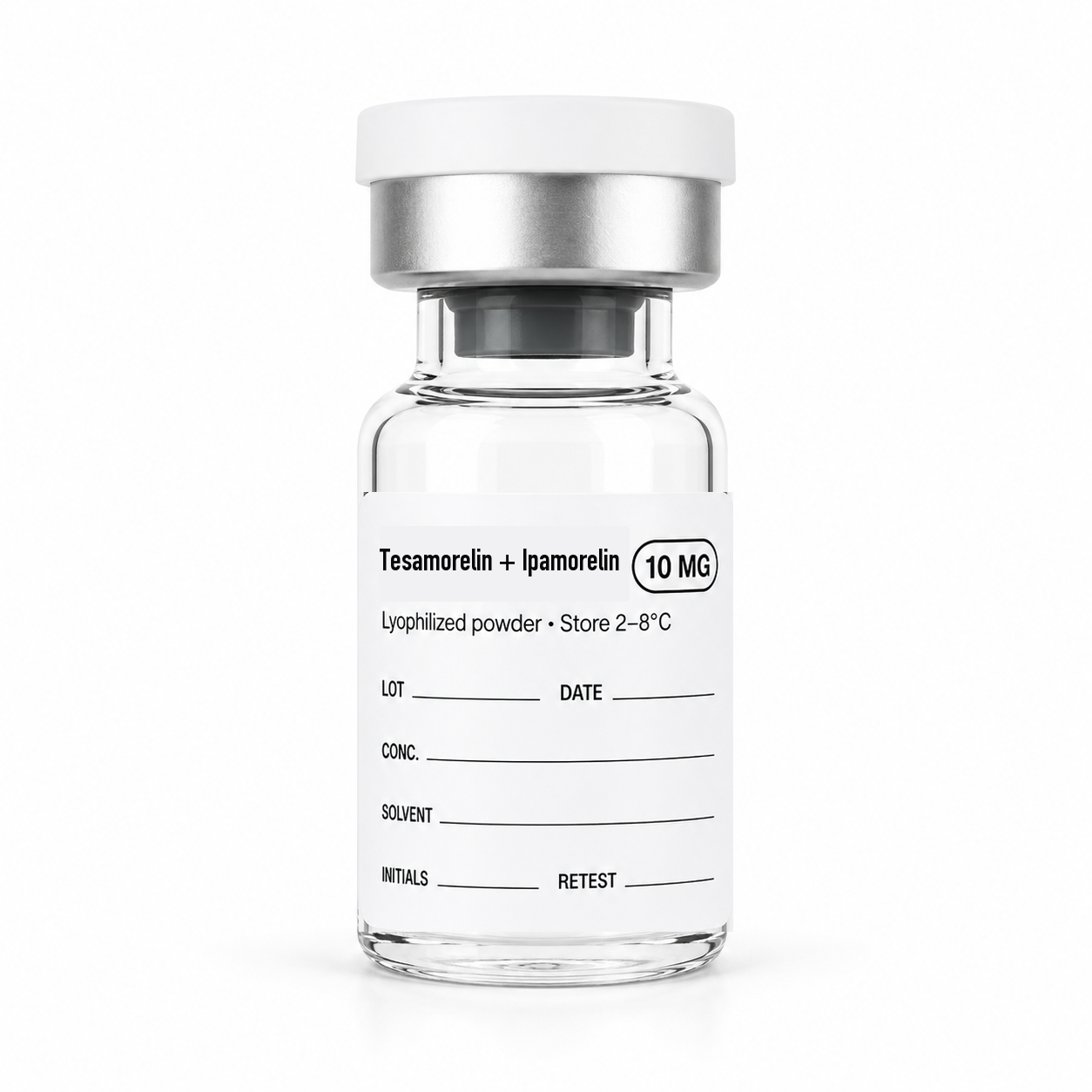
Quick Facts
Plain-English Summary
The Tesamorelin + Ipamorelin blend combines the most clinically validated GHRH analogue (Tesamorelin, FDA-approved as Egrifta) with the most selective GHRP (Ipamorelin) in a single preparation. The combination follows the established GHRH/GHRP synergy principle: Tesamorelin activates the GHRH receptor to amplify GH pulse amplitude, while Ipamorelin activates the ghrelin receptor (GHS-R1a) to further augment GH release through a complementary intracellular pathway. The result is synergistic GH pulse amplification that is greater than either compound alone.
This blend represents a premium positioning in the GH secretagogue market given Tesamorelin's RCT evidence base — though the specific combination has not been studied in any controlled trial. Tesamorelin has multiple published Phase III RCTs demonstrating visceral fat reduction of ~15–20% from baseline in HIV-associated lipodystrophy, making it the highest-evidence GHRH analogue available in the research compound category.
Tesamorelin's RCT evidence is specific to HIV-associated lipodystrophy. Applying this data to healthy adults or to the combination formulation requires extrapolation. The blend itself has not been studied in any registered controlled trial as of 2026.
Ipamorelin contributes the complementary ghrelin receptor arm of dual-pathway GH stimulation. It is distinguished among GHRPs by its selectivity — minimal stimulation of cortisol, prolactin, or ACTH compared to GHRP-2 or GHRP-6. This selectivity profile makes it the preferred GHRP component for combination formulations targeting GH optimisation with minimal off-target endocrine effects.
Mechanism of Action
Proposed mechanisms below are derived from in vitro and rodent studies only. No mechanistic pathway has been validated in a controlled human study.
All mechanistic data is derived from in vitro or rodent studies. Applicability of these pathways in humans is not established.
Animal Data
| Model | Finding | ICPS Status |
|---|---|---|
| Tesamorelin — Rodent GH secretion | Full-length GHRH(1-44) analogue confirmed to drive pulsatile GH release in preclinical models; pharmacodynamic data supported the Phase III clinical programme. | Preclinical |
| Ipamorelin — Rodent GH selectivity (Raun et al. 1998) | Selective GHS-R1a agonism with minimal cortisol/prolactin stimulation confirmed across multiple rodent models. Selectivity profile comprehensively characterised vs. GHRP-2 and GHRP-6. Raun et al. 1998 ↗ | Preclinical |
| Ipamorelin — Rat longitudinal bone growth | Confirmed GH-mediated longitudinal bone growth induction in rats at therapeutic doses. Consistent with GHS-R1a activation and IGF-1 elevation. Johansen et al. 1999 ↗ | Preclinical |
| Tesamorelin + Ipamorelin — Combination | No animal studies have specifically examined this combination formulation. Combination effects are inferred from the established GHRH/GHRP synergy principle demonstrated with other compound pairs. | No Combination Data |
No finding from this section has been replicated in a controlled human trial. Animal-to-human translation for peptides is uncertain and cannot be assumed.
Human Trials
| Trial | Population | Status | ICPS Status |
|---|---|---|---|
| Tesamorelin Phase III — HIV Lipodystrophy (Falutz et al. 2010) | 816 patients, Tesamorelin 2 mg/day vs. placebo, 26 weeks; primary endpoint visceral adipose tissue reduction | — | Registered RCT |
| Tesamorelin Phase III extension (Stanley/Falutz 2012) | Extension of Phase III programme; functional outcomes in older adults with HIV | — | Registered RCT |
| Ipamorelin — Phase IIb postoperative ileus | Adult post-surgical patients; GI motility endpoint | — | Phase IIb |
| Tesamorelin + Ipamorelin Blend — Any indication | — | — | No Data |
Tesamorelin + Ipamorelin has no FDA, EMA, or Health Canada–approved indications and no published Phase III trial data for any condition as of 2026.
Safety & Side Effects
Phase III safety data documents injection site reactions (most common), peripheral oedema, arthralgia, and glucose metabolism considerations. Elevated IGF-1 requires monitoring. Data is robust given Phase III RCT size; applies to Tesamorelin as monotherapy.
The most tolerable GHRP. Minimal cortisol, prolactin, and ACTH stimulation distinguishes it from GHRP-2 and GHRP-6. Phase IIb data provides human safety context. No pharmacovigilance database exists for long-term use.
- Injection site redness and mild soreness
- Water retention, particularly in early use
- Transient fatigue or lethargy at initiation
- Mild tingling or paraesthesia in extremities
- No pharmacovigilance database for the combination
- IGF-1 levels — elevated IGF-1 associated with acromegaly risk
- Fasting glucose and HbA1c — GH can impair insulin sensitivity
- Active or suspected malignancy
- Pregnancy or breastfeeding
- Children and adolescents (open growth plates)
Tesamorelin + Ipamorelin is not approved by the FDA, EMA, or Health Canada for any medical indication. It is classified as a research compound and is not legal for human therapeutic use in most jurisdictions. Procurement and use outside of registered clinical trials carries regulatory and unknown health risks.
References
Research disclaimer. CompoundProfile publishes summaries of available scientific literature for educational purposes only. This page does not constitute medical advice and should not be interpreted as an endorsement of Tesamorelin + Ipamorelin for any therapeutic use. Consult a licensed healthcare professional before considering any research compound. All evidence gradings reflect the state of published literature as of September 2026 and are assessed independently by ICPS.
Community Commentary
Selected discussion from r/Peptides · Curated for signal, not volume
This is my current protocol — prescribed Tesamorelin off-label combined with Ipamorelin. The rationale for using Tesamorelin over Mod GRF is the actual Phase III data. I'm paying more but I'm using the compound that went through proper trials.
The Falutz NEJM paper is compelling. Interesting choice to blend with Ipa over running Tesamorelin solo.
The upgrade from CJC/Ipa to Tesa/Ipa is justified if you're serious about evidence. Tesamorelin is the premium GHRH option. Same dual-receptor principle but with a more studied foundation.
Worth being precise here: Tesamorelin's RCT evidence is for HIV lipodystrophy specifically. The mechanism is sound for general visceral fat reduction but we're extrapolating when applying it to healthy adults. Good extrapolation, but extrapolation nonetheless.
Fully acknowledged. But it's still the highest-evidence extrapolation available in this compound category.
The GHRH/GHRP synergy principle is well established across multiple compound pairs. Tesamorelin + Ipamorelin follows the same logic as CJC/Ipa — GHRH receptor + ghrelin receptor co-stimulation. The advantage here is using components with stronger individual evidence bases.