Quick Facts
Plain-English Summary
GLP-2 (Glucagon-Like Peptide-2) is a 33-amino-acid peptide hormone produced and secreted by enteroendocrine L-cells in the distal small intestine and colon in response to nutrient ingestion. It was first characterised by Drucker and colleagues in the early 1990s and found to be a potent trophic factor for intestinal epithelium — one of the most specific intestinotrophic signals identified in mammalian physiology. Unlike many peptides studied in the compounding space, GLP-2 has a well-mapped receptor system, a defined endogenous role, and — through its analogue teduglutide — a substantive regulatory approval history.
Native GLP-2 is rapidly inactivated by the enzyme dipeptidyl peptidase-4 (DPP-4), which cleaves the peptide at its N-terminus within minutes of secretion. This severely limits its therapeutic utility. Teduglutide addresses this limitation through a single amino acid substitution at position 2 (glycine replaced with alanine), rendering the molecule DPP-4-resistant and extending the effective half-life from approximately 7 minutes to roughly 2 hours following subcutaneous administration. This distinction is pharmacologically critical: the clinical trial data — including the STEPS Phase III trial that supported FDA approval — was generated using teduglutide, not native GLP-2.
The approved indication is Short Bowel Syndrome with intestinal failure (SBS-IF), a condition in which surgical resection of the small intestine leaves patients chronically dependent on parenteral nutrition (PN) for caloric support. Teduglutide reduces PN requirements by stimulating intestinal adaptation: increasing villus height, deepening crypts, and expanding the mucosal absorptive surface area. In the STEPS trial (Jeppesen PB et al., 2012), 63% of teduglutide-treated patients achieved a clinically meaningful reduction in weekly PN volume (defined as ≥20% reduction) compared with 30% of placebo-treated patients.
Research interest has extended to inflammatory bowel disease and Crohn's disease, where intestinal mucosal repair is therapeutically desirable. Phase II data exists for Crohn's disease (Buchman et al.) showing improved disease activity indices. However, these indications are not approved, and the benefit-risk profile in immunologically active disease — where intestinotrophic stimulation could have mixed effects — remains under investigation.
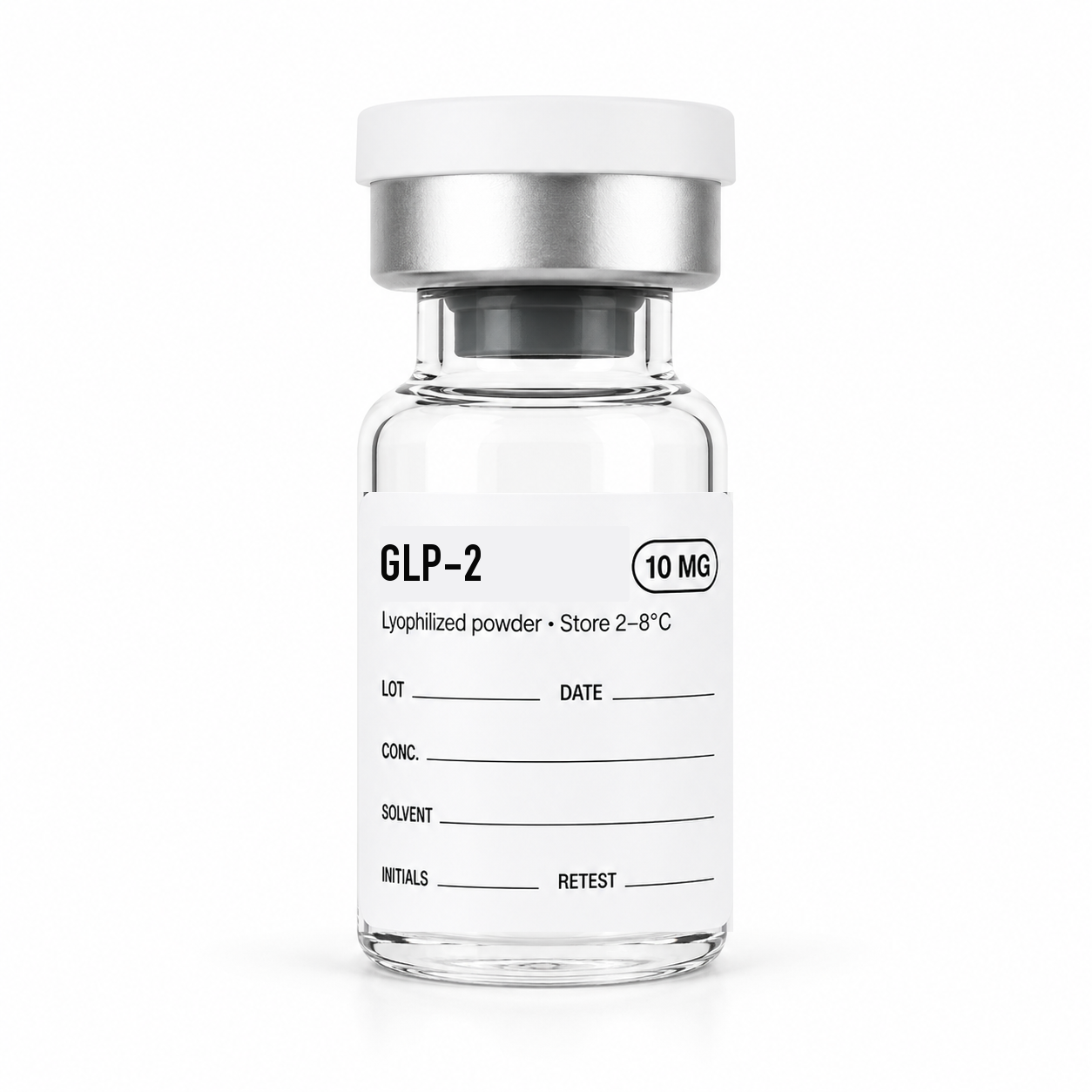
The compounded peptide market has introduced both native GLP-2 and teduglutide-like analogues as research compounds. Neither is approved for human use outside the prescription teduglutide (Gattex/Revestive) pathway. The distinction matters: native GLP-2 is rapidly degraded and would require much higher or more frequent dosing to replicate teduglutide pharmacokinetics; and the clinical safety data, including the known polyp formation signal, was characterised in the context of teduglutide's pharmacokinetic profile, not native GLP-2's.
Mechanism of Action
Proposed mechanisms below are derived from in vitro and rodent studies only. No mechanistic pathway has been validated in a controlled human study.
All mechanistic data is derived from in vitro or rodent studies. Applicability of these pathways in humans is not established.
Animal Data
| Model | Finding | ICPS Status |
|---|---|---|
| Rat short bowel syndrome (SBS) | GLP-2 administration significantly increased small intestinal weight, villus height, and crypt depth in bowel-resected rats. Enhanced absorptive capacity confirmed by nutrient transport assays. Foundational preclinical work supporting the drug development programme. Drucker DJ et al. 1996 ↗ | Preclinical |
| Neonatal piglet SBS model | Teduglutide increased intestinal wet weight, villus height, and protein content vs. controls in a surgical SBS model. Dose-dependent intestinal adaptation confirmed in a large-animal model with closer GI anatomy to humans than rodents. | Preclinical |
| Mouse colitis (DSS model) | GLP-2 reduced colonic mucosal damage, lowered inflammatory cytokine expression (TNF-α, IL-6), and preserved barrier integrity. Relevant to IBD research interest, though direct translation to human colitis is not established. | Preclinical |
| Rat intestinal ischaemia-reperfusion | GLP-2 pretreatment reduced ischaemia-reperfusion injury severity, preserved villus architecture, and decreased mucosal apoptosis. Proposed mechanism: anti-apoptotic signalling downstream of GLP-2R. | Preclinical |
| Rodent polyp / neoplasia models | GLP-2 administration accelerated proliferation of pre-existing intestinal polyps in Apc-mutant (Min/+) mice. This finding directly informed the FDA requirement for colonoscopic screening in teduglutide-treated patients before and during therapy. Iakoubov R et al. 2007 ↗ | Safety Signal |
No finding from this section has been replicated in a controlled human trial. Animal-to-human translation for peptides is uncertain and cannot be assumed.
Human Trials
| Trial | Population | Status | ICPS Status |
|---|---|---|---|
| STEPS Trial — Phase III Jeppesen PB et al., 2012 | 83 SBS-IF patients; teduglutide 0.05 mg/kg/day SC vs. placebo; 24 weeks | — | FDA Approved |
| STEPS-2 — Open-Label Extension O'Keefe SJ et al., 2013 | 65 SBS-IF patients completing STEPS; up to 24 months teduglutide | — | Published |
| Crohn's Disease — Phase II Buchman AL et al. | SBS patients with Crohn's; teduglutide dose-ranging | — | Phase II |
| Native GLP-2 — Pharmacokinetic Studies | Healthy volunteers; IV and SC native GLP-2 | — | PK Data |
| Compounded GLP-2 / GLP-2 analogues | — | — | No Data |
GLP-2 / Teduglutide has no FDA, EMA, or Health Canada–approved indications and no published Phase III trial data for any condition as of 2026.
Safety & Side Effects
The most clinically significant safety signal for teduglutide is intestinal polyp formation. GLP-2R stimulation promotes mucosal cell proliferation — a mechanism that can accelerate the growth of pre-existing polyps or dysplastic tissue. FDA labelling requires colonoscopic evaluation within 6 months prior to initiating teduglutide and at least every 5 years during treatment. This risk is real, not theoretical, and represents the primary monitoring burden associated with teduglutide therapy.
- Abdominal pain and distension (most common)
- Nausea and vomiting
- Injection site reactions
- Fluid retention / peripheral oedema
- Headache
- Upper respiratory tract infections
Rapid mucosal proliferation in patients with pre-existing stomas or strictures can increase the risk of intestinal obstruction. Reported in post-marketing surveillance. Patients with intestinal anatomy that already poses obstructive risk require close monitoring. Stoma output changes are an early warning sign in clinical practice.
- Active or suspected GI malignancy
- Unresected colorectal polyps
- Pregnancy or breastfeeding (limited data)
- Known hypersensitivity to teduglutide or excipients
- Hepatic impairment (dose adjustment may be required)
- Use of compounded GLP-2 outside approved clinical protocols
GLP-2 / Teduglutide is not approved by the FDA, EMA, or Health Canada for any medical indication. It is classified as a research compound and is not legal for human therapeutic use in most jurisdictions. Procurement and use outside of registered clinical trials carries regulatory and unknown health risks.
References
Research disclaimer. CompoundProfile publishes summaries of available scientific literature for educational purposes only. This page does not constitute medical advice and should not be interpreted as an endorsement of GLP-2 / Teduglutide for any therapeutic use. Consult a licensed healthcare professional before considering any research compound. All evidence gradings reflect the state of published literature as of September 2026 and are assessed independently by ICPS.
Community Commentary
Selected discussion from r/Peptides · Curated for signal, not volume
The distinction between native GLP-2 and teduglutide gets glossed over constantly in this space, and it really matters. Teduglutide isn't just a "cleaner" version of GLP-2 — the DPP-4 resistance is what makes it therapeutically meaningful. Native GLP-2 is gone in 7 minutes. You'd need either continuous infusion or extremely frequent dosing to replicate anything like teduglutide pharmacokinetics using the native peptide. The compounded GLP-2 vials being sold with Gattex-level outcome claims are making a pharmacological leap that the evidence doesn't support. That said, the receptor biology is real and compelling — GLP-2R agonism is genuinely one of the most powerful gut-trophic signals we know of.
Agreed. I work with SBS patients on Gattex and the results in the right indication are genuinely impressive — we're talking about people reducing or eliminating parenteral nutrition after years of full dependence. That's a profound outcome. But the people buying compounded GLP-2 for general gut healing or IBD without SBS are operating well outside the evidence base. The colonoscopy requirement alone should give anyone pause — it exists because the proliferative stimulus is real and non-trivial.
What makes GLP-2 unusual in the peptide research space is that it actually has a mechanistically coherent basis for its claimed effects, a clean receptor, and legitimate Phase III data. That's a rarity. The contrast with compounds like BPC-157 — where the mechanism is still being argued about after 30 years of rodent studies — is stark. If you're interested in gut peptides, GLP-2R agonism is probably the most validated target. The question isn't whether the mechanism works; it's whether unregulated compounded versions deliver anything like the clinical teduglutide experience. Probably not, given the half-life problem.
The IBD angle is the interesting research frontier. Crohn's specifically — where mucosal healing is both measurable and therapeutically meaningful — seems like a plausible extension of the SBS evidence. The Buchman Phase II data wasn't negative; it just wasn't powered for a regulatory submission. I'd watch for properly designed Phase III IBD trials as the most meaningful next development in this space. If those come through, the GLP-2 profile changes substantially. Until then, SBS is the evidence base and everything else is extrapolation.
The tension in IBD is that the proliferative mechanism that's beneficial in SBS might be mixed in active inflammatory disease. You're asking mucosal cells to proliferate faster in an environment that's already immunologically dysregulated. The mouse DSS colitis data is encouraging but that's a very different model from human Crohn's. This needs human trials — the rodent-to-human translation problem applies here the same as anywhere else.
The polyp colonoscopy requirement in the Gattex label gets treated as bureaucratic overhead in community discussions, but it's there because the signal was real in preclinical data. GLP-2R stimulation is pro-proliferative in colon tissue. If you have undetected adenomas and start a GLP-2R agonist, you may be accelerating their growth. That's not a hypothetical — it's why the FDA required a monitoring protocol as a condition of approval. Anyone using compounded GLP-2 without prior colonoscopic clearance is bypassing a legitimate safety gate, not a regulatory formality.