Quick Facts
Plain-English Summary
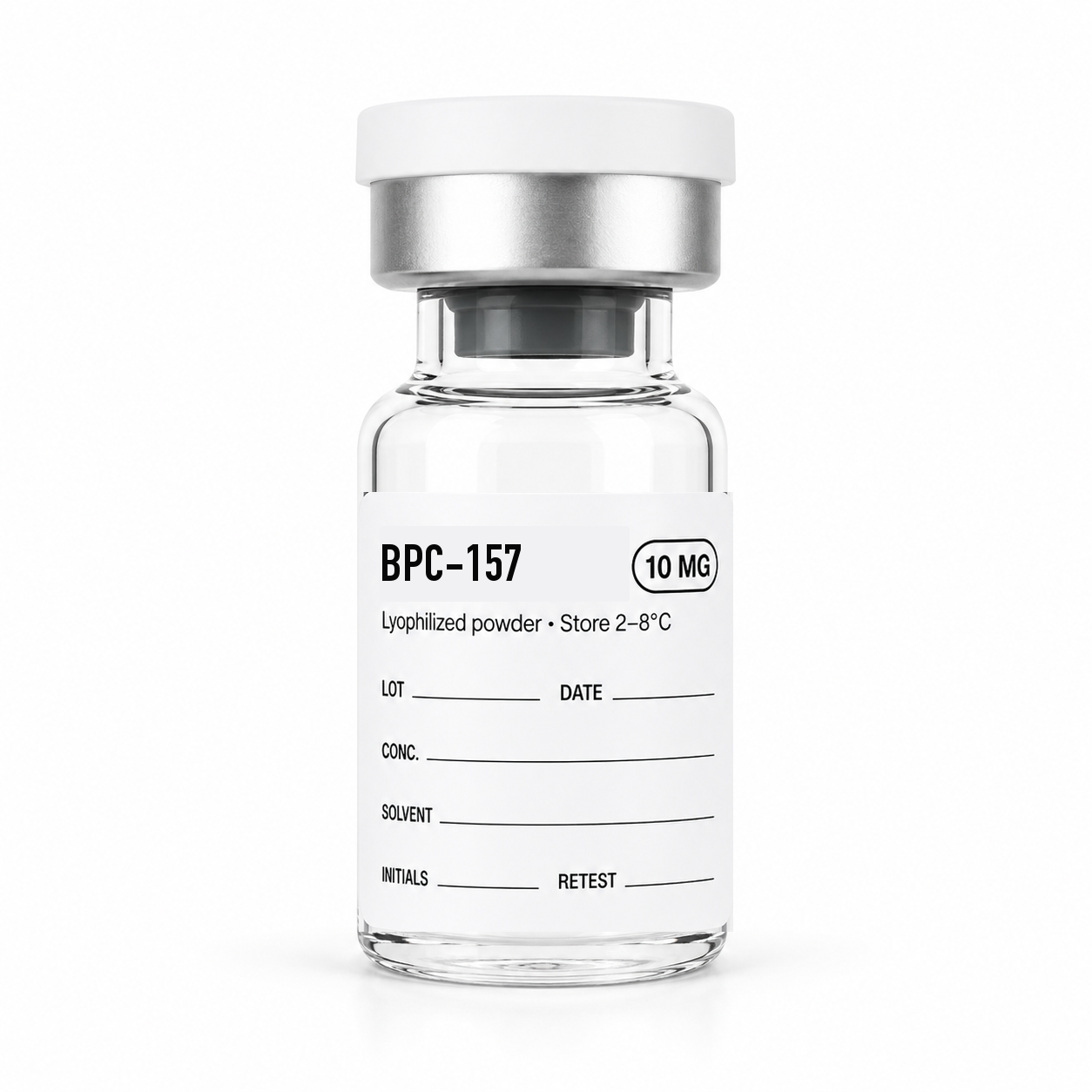
BPC-157 is a synthetic peptide consisting of 15 amino acids, derived from a naturally occurring protein found in human gastric juice. It was identified and isolated by Predrag Sikiric and colleagues at the University of Zagreb in the early 1990s, where it has been studied extensively ever since. The peptide does not exist in this exact form in nature — it is a truncated, stable analogue developed for research purposes.
The compound's most consistent finding across animal studies is its apparent ability to accelerate tissue repair. In rodent models, BPC-157 has been shown to promote healing of tendons, muscles, bone, and gastrointestinal tissue at doses ranging from 1 to 10 micrograms per kilogram. It appears to work through several overlapping pathways, most notably the upregulation of growth factors (VEGF, EGF) and the nitric oxide system, which together drive angiogenesis — the formation of new blood vessels — at injury sites.
Gastrointestinal effects are among the best-documented in preclinical literature. BPC-157 has been shown to protect the gastric mucosa, accelerate ulcer healing, and reduce intestinal inflammation in rodent colitis models. This aligns with its origin as a gastric protein fragment, which may explain its apparent activity in gut tissue.
The overwhelming majority of BPC-157 research originates from a single laboratory group at the University of Zagreb. Independent replication across different institutions is very limited — a significant constraint on interpreting this body of evidence.
Human data is sparse. A single Phase II trial conducted in the 1990s tested BPC-157 in patients with ulcerative colitis and reported modest improvements in disease activity scores. That trial has not been published in full peer-reviewed form, and no additional registered human trials have been completed as of 2026. The leap from rodent findings to human therapeutic use is large and currently unsupported by a clinical evidence base.
Mechanism of Action
Proposed mechanisms below are derived from in vitro and rodent studies only. No mechanistic pathway has been validated in a controlled human study.
All mechanistic data is derived from in vitro or rodent studies. Applicability of these pathways in humans is not established.
Animal Data
| Model | Finding | ICPS Status |
|---|---|---|
| Rat tendon transection | Near-complete tendon healing at 4 weeks vs. untreated controls. Effect dose-dependent (1–10 μg/kg). Staresinic et al. 2003 ↗ | Preclinical |
| Rat gastric ulcer | 83% reduction in ulcer area at standard dose. Reproduced across ethanol, indomethacin, and stress induction models. Sikiric et al. 1994 ↗ | Preclinical |
| Rat spinal cord injury | Partial motor recovery vs. sham at 4 weeks post-injury. Proposed mechanism: NO pathway and anti-inflammatory signalling. Gjurasin et al. 2010 ↗ | Preclinical |
| Rat colitis (TNBS) | Significant reduction in colonic inflammation markers and mucosal damage score. Replicated across multiple colitis models. Sikiric et al. 2007 ↗ | Preclinical |
| Rat alcohol hepatotoxicity | Attenuated hepatocyte damage and transaminase elevation in ethanol model. Proposed mechanism: oxidative stress pathway modulation. | Preclinical |
| Rat dopamine dysregulation | Partial restoration of dopamine function post-basal ganglia lesion. Cited in community as evidence for mood effects — human relevance unknown. | Preclinical |
No finding from this section has been replicated in a controlled human trial. Animal-to-human translation for peptides is uncertain and cannot be assumed.
Human Trials
| Trial | Population | Status | ICPS Status |
|---|---|---|---|
| Phase II — Ulcerative Colitis | 62 patients, oral BPC-157 vs. placebo, 4 weeks | — | Incomplete |
| All other indications | — | — | No Data |
BPC-157 has no FDA, EMA, or Health Canada–approved indications and no published Phase III trial data for any condition as of 2026.
Safety & Side Effects
No significant toxicity observed at therapeutic doses in rodent models across multiple research groups. No mutagenicity, carcinogenicity, or organ toxicity reported in preclinical literature at standard dose ranges.
Pro-angiogenic mechanisms (VEGF upregulation, NO pathway) could theoretically accelerate tumour vascularisation in individuals with existing or undetected malignancy. No human data exists to quantify this risk.
- Injection site redness and mild soreness
- Transient headache in first days of use
- Mild nausea, especially with oral dosing
- Vivid dreams (mechanism unknown)
- No pharmacovigilance database exists for BPC-157
- Active or suspected malignancy
- Pregnancy or breastfeeding
- Immunosuppressive therapy
- Hormone-sensitive conditions
- Children and adolescents
BPC-157 is not approved by the FDA, EMA, or Health Canada for any medical indication. It is classified as a research compound and is not legal for human therapeutic use in most jurisdictions. Procurement and use outside of registered clinical trials carries regulatory and unknown health risks.
References
Research disclaimer. CompoundProfile publishes summaries of available scientific literature for educational purposes only. This page does not constitute medical advice and should not be interpreted as an endorsement of BPC-157 for any therapeutic use. Consult a licensed healthcare professional before considering any research compound. All evidence gradings reflect the state of published literature as of September 2026 and are assessed independently by ICPS.
Community Commentary
Selected discussion from r/Peptides · Curated for signal, not volume
The VEGF upregulation piece is probably the most mechanistically interesting part of BPC-157's profile. Sikiric's group has shown consistent FAK–paxillin pathway activation across multiple tissue models, which would explain the cross-system effects — tendon, gut mucosa, cardiac muscle — that otherwise look implausibly broad. What I'd want to see is whether the effect persists after systemic dosing in non-rodent models. Every compelling result so far is either intragastric or local injection in rat. The oral bioavailability question is genuinely unresolved and people hand-wave past it constantly.
Agreed on the bioavailability problem. A 15-residue peptide is going to face significant proteolytic degradation before reaching systemic circulation via oral route. The gastric cytoprotection effects might be entirely paracrine — acting locally on the mucosa before degradation — which would explain why the GI data is so much stronger than the peripheral tissue data. That's not a knock on it, but it does change the mechanistic interpretation substantially.
Something that gets underreported: the eNOS upregulation pathway is probably doing significant work in the vascular repair data. BPC-157 appears to increase NO bioavailability in endothelium, which alone would account for several of the wound-healing and anastomosis repair findings without requiring anything exotic. I'd treat the more dramatic CNS dopamine interaction data with more skepticism — those studies are much thinner and harder to replicate independently.
The human data problem here isn't just quantity — it's that we have zero pharmacokinetic studies in humans, zero dose-ranging data, and the one Croatian Phase II trial on inflammatory bowel disease was never published in full. That's a meaningful gap. Sikiric's lab has produced hundreds of rodent papers but appears to have little interest in the translational work that would actually tell us whether any of this scales. Until someone runs a proper PK study in humans with confirmed plasma concentrations, the dosing protocols circulating in self-experimentation communities are essentially guesswork.
This is the honest summary. Strong mechanistic plausibility, very strong rodent data, and a near-complete absence of the translational work that would justify clinical confidence. It's not that the compound is implausible — it's that the research program seems structurally uninterested in the questions that matter most for human use.
For what it's worth from a clinical standpoint: the GI cytoprotection data is the most credible part of the profile by a significant margin. The mechanism (upregulating prostaglandin synthesis, modulating gastric acid secretion, promoting mucosa restitution) is coherent and well-precedented. If this compound ever reaches meaningful clinical use, I'd bet on a gastroprotective indication before anything involving tendon or CNS. Those are mechanistically interesting but the evidence quality doesn't match the enthusiasm.