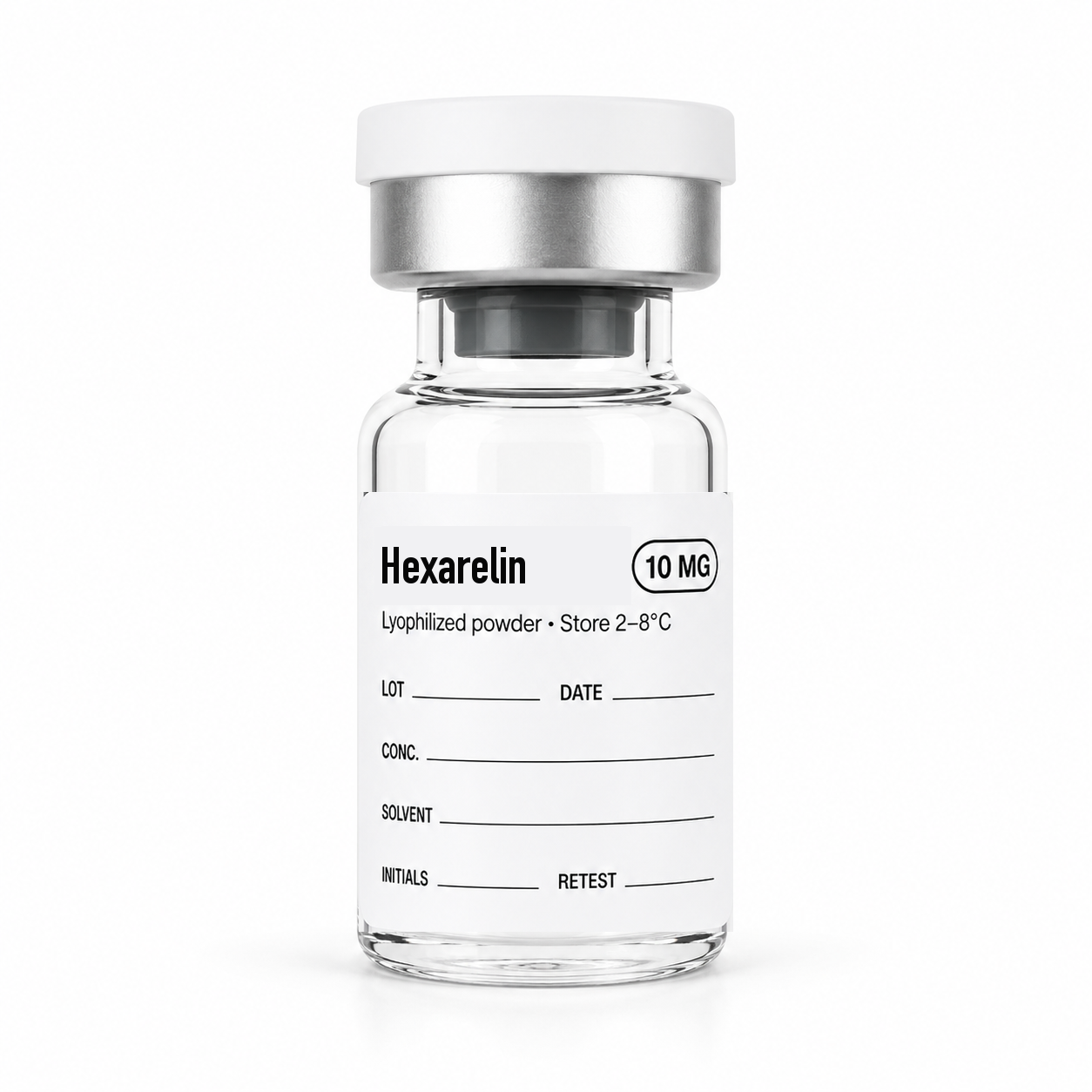
Quick Facts
Plain-English Summary
Hexarelin is a synthetic growth hormone-releasing peptide (GHRP) designed as an analogue of GHRP-6, with a D-2-methyltryptophan substitution that increases potency and metabolic stability. It stimulates pulsatile GH release from the pituitary by activating ghrelin receptors (GHSR-1a), and in animal studies produces robust, dose-dependent GH spikes — generally stronger per microgram than GHRP-6 or ipamorelin.
What distinguishes hexarelin from other GHRPs is its activity at the CD36 scavenger receptor in cardiac tissue. Multiple peer-reviewed studies, primarily in rodent and porcine models, have demonstrated that hexarelin reduces myocardial ischemia-reperfusion injury, preserves cardiac function after infarct, and exerts anti-apoptotic effects in cardiomyocytes — effects that appear to be independent of GH secretion, as they persist in hypophysectomized animals.
Human data is sparse. A handful of small studies in adults with GH deficiency confirmed that hexarelin raises GH and IGF-1, but no controlled trials exist for its cardiac or body composition claims. A critical limitation is rapid tachyphylaxis: repeated dosing within 24 hours blunts the GH response significantly, and continuous administration can nearly abolish it. This desensitization drives most research protocols toward cycling strategies (4–6 weeks on, break) rather than sustained use.
Tachyphylaxis warning: Unlike ipamorelin, hexarelin exhibits rapid receptor desensitization with repeated dosing. The GH response diminishes substantially within a cycle if used more than twice daily. This is a well-documented pharmacological property, not a vendor concern — it should inform any research protocol design.
The cardioprotective research is scientifically compelling but has not progressed to human trials. Translation from rodent cardiac injury models to human benefit cannot be assumed. No safety data from long-term human use exists in the peer-reviewed literature.
Mechanism of Action
Proposed mechanisms below are derived from in vitro and rodent studies only. No mechanistic pathway has been validated in a controlled human study.
All mechanistic data is derived from in vitro or rodent studies. Applicability of these pathways in humans is not established.
Animal Data
| Model | Finding | ICPS Status |
|---|---|---|
| Rat — cardiac ischemia-reperfusion | Hexarelin (80 mcg/kg IV) reduced infarct size by 30% and improved post-ischemic cardiac function; effects persisted in hypophysectomized animals, confirming GH-independent mechanism. Locatelli et al. 1999 ↗ | Preclinical |
| Porcine — post-MI cardiac function | Hexarelin infusion improved ejection fraction and reduced fibrosis markers after induced myocardial infarction in pigs — a closer translational model to humans than rodents. Fazio et al. 2001 ↗ | Preclinical |
| Rat — GH secretion dose-response | Subcutaneous hexarelin 100–200 mcg/kg produced robust GH pulses exceeding those of GHRP-6 at equimolar doses; dose-dependent tachyphylaxis observed with twice-daily administration over 7 days. | Preclinical |
| Rat — CD36 knockout model | Cardioprotective effects of hexarelin were abolished in CD36-null mice, confirming receptor-specific mechanism for cardiac protection independent of GHSR-1a signaling. Marleau et al. 2012 ↗ | Preclinical |
No finding from this section has been replicated in a controlled human trial. Animal-to-human translation for peptides is uncertain and cannot be assumed.
Human Trials
| Trial | Population | Status | ICPS Status |
|---|---|---|---|
| GH deficiency — pituitary stimulation test | Adults with confirmed GH deficiency | — | Limited |
| Cardiac function (heart failure) | — | — | No Data |
| All body composition indications | — | — | No Data |
HEXARELIN has no FDA, EMA, or Health Canada–approved indications and no published Phase III trial data for any condition as of 2026.
Safety & Side Effects
In small human GH stimulation studies, hexarelin was generally well tolerated at diagnostic doses. Adverse events were transient and included mild facial flushing, increased appetite, and transient water retention — consistent with GH-class effects. No serious adverse events were reported in the limited published data.
No long-term safety data exists in humans. Repeated supraphysiologic GH stimulation carries theoretical risks including insulin resistance, soft tissue edema, and potential carcinogenic promotion in pre-existing malignancy. Rapid tachyphylaxis may limit toxicity from extended dosing but this has not been systematically evaluated.
- Increased hunger / food cravings
- Water retention / mild bloating
- Flushing or warmth post-injection
- Fatigue or lethargy at higher doses
- Tingling (paresthesia) — rare
- Active or suspected malignancy
- Pregnancy or breastfeeding
- Uncontrolled diabetes (GH can worsen insulin resistance)
- Children and adolescents
- History of pituitary tumor or pituitary surgery
HEXARELIN is not approved by the FDA, EMA, or Health Canada for any medical indication. It is classified as a research compound and is not legal for human therapeutic use in most jurisdictions. Procurement and use outside of registered clinical trials carries regulatory and unknown health risks.
References
Research disclaimer. CompoundProfile publishes summaries of available scientific literature for educational purposes only. This page does not constitute medical advice and should not be interpreted as an endorsement of HEXARELIN for any therapeutic use. Consult a licensed healthcare professional before considering any research compound. All evidence gradings reflect the state of published literature as of September 2026 and are assessed independently by ICPS.
Community Commentary
Selected discussion from r/Peptides · Curated for signal, not volume
Hexarelin hits harder than ipamorelin for sure. First two weeks the hunger and the flush were pretty intense. The tachyphylaxis is real though — by week 5 I was getting noticeably diminishing returns. I run it 4 weeks on, 8 off and that seems to preserve the response. Don't expect ipamorelin-level sustained use.
The CD36 cardiac data is legitimately interesting to me as someone who works in cardiology research. The fact that these effects survive hypophysectomy means it's not just a GH story. I'm cautious about extrapolating to humans but as a research target it's compelling. We're nowhere near knowing if it helps humans though.
I stack hexarelin with mod GRF 1-29 and the synergy is very noticeable vs using either alone. Better sleep quality and the joint recovery improvement is real for me post-training. Appetite suppression from ipamorelin is nicer if you're cutting though — hexarelin makes me ravenous.
Vendors oversell this as a "heart-protecting GH peptide." The cardiac data is rodent/porcine only and the doses used are very high. Nobody knows if these doses do anything useful in an otherwise healthy human heart. Source: I actually read the papers.