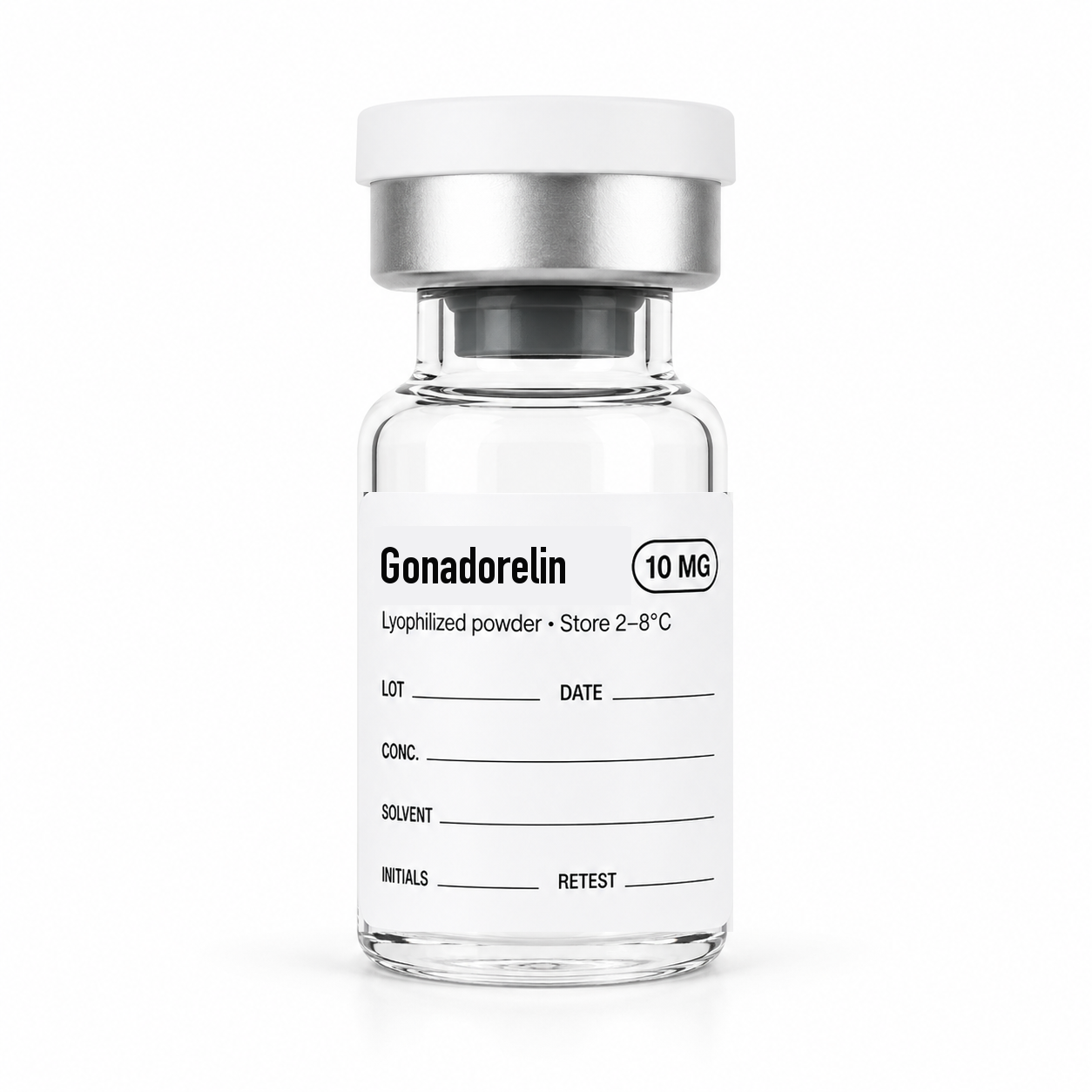
Quick Facts
Plain-English Summary
Gonadorelin is the synthetic equivalent of the body's own gonadotropin-releasing hormone, produced by the hypothalamus in pulses every 60–120 minutes. These pulses stimulate the anterior pituitary to release LH and FSH, which in turn stimulate testicular Leydig and Sertoli cells to produce testosterone and support spermatogenesis. When exogenous testosterone is administered, the hypothalamus suppresses GnRH, causing LH/FSH to fall and testes to become inactive — the basis for testicular atrophy.
Gonadorelin's theoretical role in TRT is to replace the suppressed GnRH signal and keep the pituitary-testicular axis active. This would preserve Leydig cell function, testicular volume, and spermatogenesis. In practice, the approach faces a significant pharmacokinetic challenge: native GnRH has a plasma half-life of 2–8 minutes, and the pituitary responds to pulsatile — not continuous — stimulation. SC injection at 100mcg twice daily does not reliably replicate the physiological 60–120 minute pulse pattern.
The evidence base specific to gonadorelin in TRT protocols is sparse. Most supporting data comes from GnRH pump therapy in men with hypogonadotropic hypogonadism — a condition where the defect is specifically hypothalamic GnRH deficiency. Men on TRT have a different physiology (suppressed, not absent, HPG axis), and the translation of pump data to SC injection protocols is not established.
Historically, hCG was preferred for this indication because it directly mimics LH, bypasses the GnRH-pituitary step, and has a much longer half-life. After FDA compound policy changes restricting compound hCG, gonadorelin became widely substituted in clinic protocols despite weaker evidence for this specific indication.
The use of gonadorelin in TRT to preserve fertility is off-label and the evidence base is substantially weaker than clinic marketing suggests. Most data comes from GnRH pump studies in a different patient population. The SC injection route does not reliably replicate physiological GnRH pulsatility. Patients considering gonadorelin for this purpose should understand the evidence limitations and discuss alternatives with a reproductive endocrinologist.
Mechanism of Action
Proposed mechanisms below are derived from in vitro and rodent studies only. No mechanistic pathway has been validated in a controlled human study.
All mechanistic data is derived from in vitro or rodent studies. Applicability of these pathways in humans is not established.
Animal Data
| Model | Finding | ICPS Status |
|---|---|---|
| Hypogonadotropic hypogonadism — GnRH pump | Pulsatile GnRH via SC pump (5–20 mcg q90–120 min) normalized testosterone, LH, FSH, and restored spermatogenesis in men with isolated GnRH deficiency. Hoffman et al. 1988 ↗ | Preclinical |
| Rat — HPG axis suppression model | Gonadorelin pulsatile infusion restored LH pulsatility and testosterone in GnRH-suppressed rats; continuous infusion paradoxically worsened suppression confirming pulsatility requirement. | Preclinical |
| Rat — fertility preservation | Pulsatile gonadorelin maintained spermatogenesis during exogenous testosterone administration in rodent model; SC bolus injections were less effective than pump delivery. | Preclinical |
No finding from this section has been replicated in a controlled human trial. Animal-to-human translation for peptides is uncertain and cannot be assumed.
Human Trials
| Trial | Population | Status | ICPS Status |
|---|---|---|---|
| FDA-approved — GnRH stimulation test | Adults — diagnostic evaluation | — | Approved |
| Off-label — TRT fertility preservation | Men on TRT | — | Limited |
| Hypothalamic amenorrhea — GnRH pump | Women with hypothalamic amenorrhea | — | Approved |
GONADORELIN has no FDA, EMA, or Health Canada–approved indications and no published Phase III trial data for any condition as of 2026.
Safety & Side Effects
Generally well tolerated at diagnostic doses (3.2–100 mcg single injection). Common effects are injection site reactions and transient headache. Rare: hypersensitivity, anaphylaxis (with repeated exposure). No known organ toxicity at studied doses.
No long-term safety data for chronic SC administration in TRT protocols. Theoretical concern: if not achieving pulsatile pituitary stimulation, chronic near-continuous GnRH exposure may paradoxically downregulate pituitary GnRH receptors, worsening rather than preventing HPG suppression.
- Injection site pain/redness
- Headache (transient)
- Flushing (rare)
- Nausea (rare)
- Known hypersensitivity to GnRH or its analogues
- Women who are pregnant (stimulates LH/FSH which can affect pregnancy)
- Concurrent GnRH antagonist use
- Hormone-sensitive cancers
GONADORELIN is not approved by the FDA, EMA, or Health Canada for any medical indication. It is classified as a research compound and is not legal for human therapeutic use in most jurisdictions. Procurement and use outside of registered clinical trials carries regulatory and unknown health risks.
References
Research disclaimer. CompoundProfile publishes summaries of available scientific literature for educational purposes only. This page does not constitute medical advice and should not be interpreted as an endorsement of GONADORELIN for any therapeutic use. Consult a licensed healthcare professional before considering any research compound. All evidence gradings reflect the state of published literature as of September 2026 and are assessed independently by ICPS.
Community Commentary
Selected discussion from r/Peptides · Curated for signal, not volume
Switched from hCG to gonadorelin when my clinic stopped offering compounded hCG. Honest assessment: my LH/FSH on bloodwork is better on gonadorelin than on nothing, but not as good as it was on hCG. Testicles haven't atrophied but I'm also not sure if the gonadorelin is doing that or just the passage of time. Hard to know without a controlled study.
Currently working with a reproductive endocrinologist trying to preserve fertility on TRT. He was skeptical of gonadorelin SC for this purpose — said the GnRH pump data doesn't translate cleanly to SC bolus dosing. Ended up recommending just stopping TRT temporarily if pregnancy is the goal.
The pharmacy side of this: gonadorelin has a very short stability window after reconstitution — 24 hours refrigerated. A lot of TRT patients don't know this. If you're not storing it correctly or using it within that window you may be injecting degraded product. hCG was much more stable.
Someone post an RCT on gonadorelin in TRT. I'll wait. Every clinic is doing it but there's basically no controlled human data on SC gonadorelin specifically for this indication. We're all running an uncontrolled experiment.