Quick Facts
Plain-English Summary
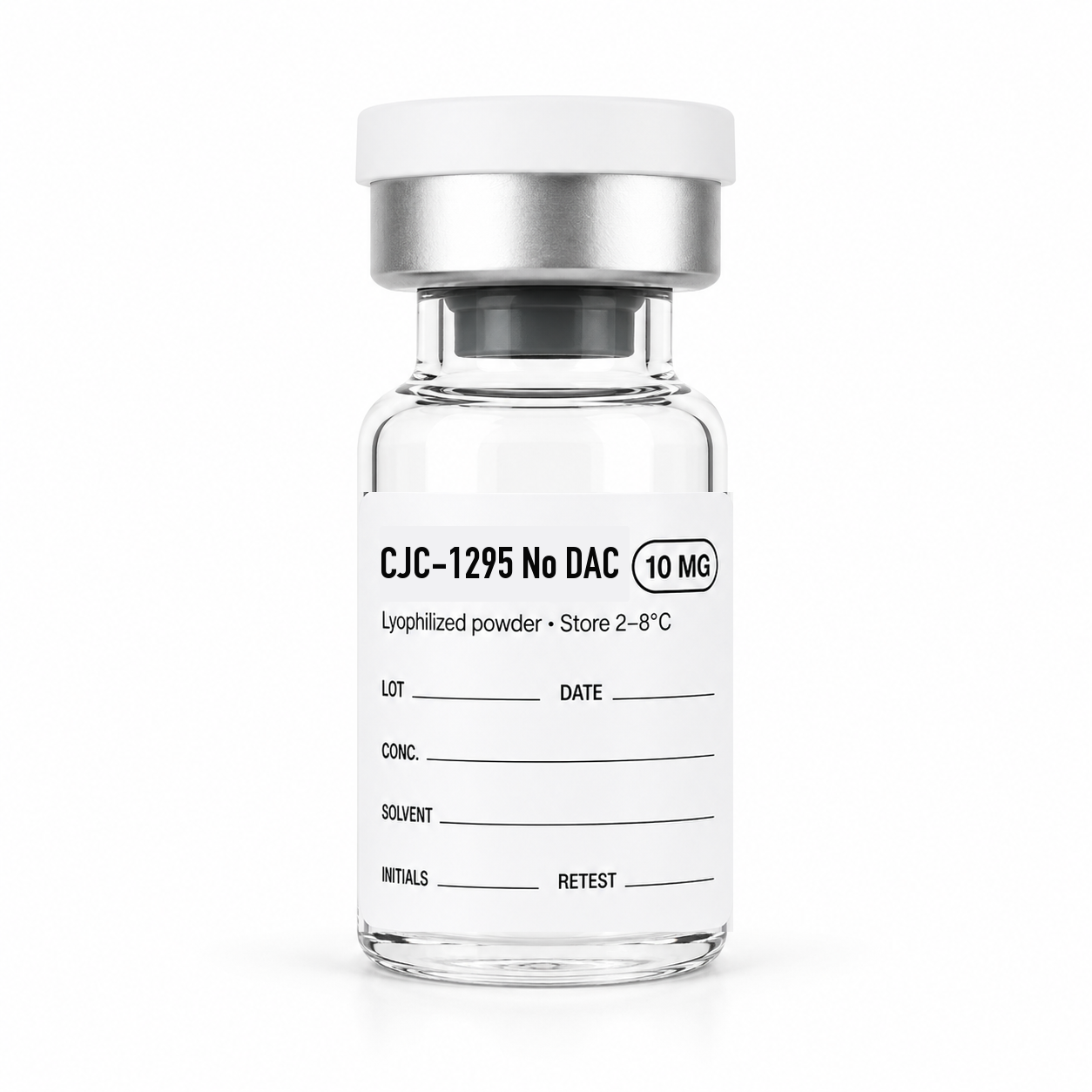
CJC-1295 no DAC (also called Modified GRF 1-29 or Mod GRF) is a stabilised 29-amino acid analogue of growth hormone-releasing hormone. Unlike CJC-1295 with DAC, this formulation lacks the Drug Affinity Complex that extends half-life, resulting in a short-acting profile (~30 minutes) that produces a single GH pulse mimicking the natural pulsatile secretion pattern. This short-acting nature is considered by many practitioners to be preferable for maintaining normal GH feedback physiology.
It is almost always combined with a GHRP (most commonly Ipamorelin) to amplify the GH pulse through complementary receptor pathways. The combination targets both the GHRH receptor and the ghrelin receptor simultaneously, producing synergistic GH release that is greater than either compound alone.
The naming confusion between "CJC-1295 no DAC" and "CJC-1295 with DAC" is widespread in the peptide market. Mod GRF 1-29 is the more scientifically precise name for the no-DAC variant. Purchasers should verify the compound they are receiving to distinguish between the short-acting and long-acting formulations.
Human data for the no-DAC variant specifically is limited. Pharmacodynamic studies have confirmed GH pulse augmentation, but no controlled outcome trials exist for body composition, performance, or anti-ageing endpoints. The evidence base relies substantially on pharmacokinetic data and extrapolation from the DAC variant literature.
Mechanism of Action
Proposed mechanisms below are derived from in vitro and rodent studies only. No mechanistic pathway has been validated in a controlled human study.
All mechanistic data is derived from in vitro or rodent studies. Applicability of these pathways in humans is not established.
Animal Data
| Model | Finding | ICPS Status |
|---|---|---|
| Rat GH secretion (GHRH analogue) | Dose-dependent GH and IGF-1 elevation following GHRH(1-29) analogue administration. Peak GH pulse achieved within 15–30 minutes with return to baseline consistent with short-acting profile. | Preclinical |
| Primate pharmacokinetics | Short-acting GH pulse characteristics confirmed in non-human primate PK studies. Single-pulse GH elevation profile similar to endogenous GHRH-driven secretion with no sustained GH elevation observed. | Preclinical |
| Rodent GHRH + GHRP combination | Synergistic GH amplification demonstrated when GHRH analogue combined with GHRP compounds across multiple rodent models. Combined GH release substantially exceeds additive effect of individual compounds. | Preclinical |
| Rat IGF-1 response (repeated dosing) | Dose-dependent IGF-1 elevation following repeated pulsatile dosing regimens. Pulsatile GH pattern produces IGF-1 responses consistent with physiological GH secretion patterns rather than continuous GH infusion profiles. | Preclinical |
No finding from this section has been replicated in a controlled human trial. Animal-to-human translation for peptides is uncertain and cannot be assumed.
Human Trials
| Trial | Population | Status | ICPS Status |
|---|---|---|---|
| Human PD studies — GH pulse | Small cohorts; single-dose GH pharmacodynamic characterisation | — | PD Only |
| Teichman et al. 2006 (DAC variant context) | 65 healthy adults; CJC-1295 with DAC (reference study) | — | Indirect |
| All outcome endpoints (body composition, performance) | — | — | No Data |
CJC-1295 No DAC has no FDA, EMA, or Health Canada–approved indications and no published Phase III trial data for any condition as of 2026.
Safety & Side Effects
CJC-1295 no DAC is generally well tolerated in self-reported use at standard research doses. The short-acting profile may reduce risk of tachyphylaxis and receptor desensitisation compared to long-acting variants. No serious adverse events are documented in observational literature at typical dosing protocols.
Elevated IGF-1 over extended periods carries theoretical risks consistent with any GH secretagogue — including accelerated growth of pre-existing malignant cells and potential insulin resistance. Long-term safety data in healthy adults is absent. No pharmacovigilance database exists specifically for this compound.
- Transient flushing or tingling at injection
- Mild water retention, especially in early use
- Injection site redness or mild soreness
- Transient fatigue or lethargy post-dose
- No pharmacovigilance database exists for CJC-1295 no DAC
- Active or suspected malignancy
- Pregnancy or breastfeeding
- Acromegaly or pituitary disease
- IGF-1-sensitive conditions
- Children and adolescents
CJC-1295 No DAC is not approved by the FDA, EMA, or Health Canada for any medical indication. It is classified as a research compound and is not legal for human therapeutic use in most jurisdictions. Procurement and use outside of registered clinical trials carries regulatory and unknown health risks.
References
Research disclaimer. CompoundProfile publishes summaries of available scientific literature for educational purposes only. This page does not constitute medical advice and should not be interpreted as an endorsement of CJC-1295 No DAC for any therapeutic use. Consult a licensed healthcare professional before considering any research compound. All evidence gradings reflect the state of published literature as of August 2026 and are assessed independently by ICPS.
Community Commentary
Selected discussion from r/Peptides · Curated for signal, not volume
Been using Mod GRF 1-29 + Ipamorelin for 8 months. IGF-1 went from 142 to 198 ng/mL. Sleep quality massively improved. No sides whatsoever. This is the most underrated stack in peptide research.
Good IGF-1 response. Did you time bloods relative to dosing? Morning fasted IGF-1 is the right metric.
The no-DAC version is the right choice if you care about maintaining your natural GH axis. DAC basically keeps GH elevated continuously which isn't how the body is designed to work.
Mod GRF is the more scientifically honest name. "CJC-1295 no DAC" is a marketing term that confuses it with actual CJC-1295 (which has the DAC). The research community calls it modified GRF 1-29.
Completely agree. The naming in the peptide market is deliberately confusing.
What distinguishes this from Sermorelin is the four amino acid substitutions that increase DPP-IV resistance. Sermorelin is the FDA-approved equivalent with shorter in-vivo stability. For research purposes, Mod GRF is the cleaner compound.