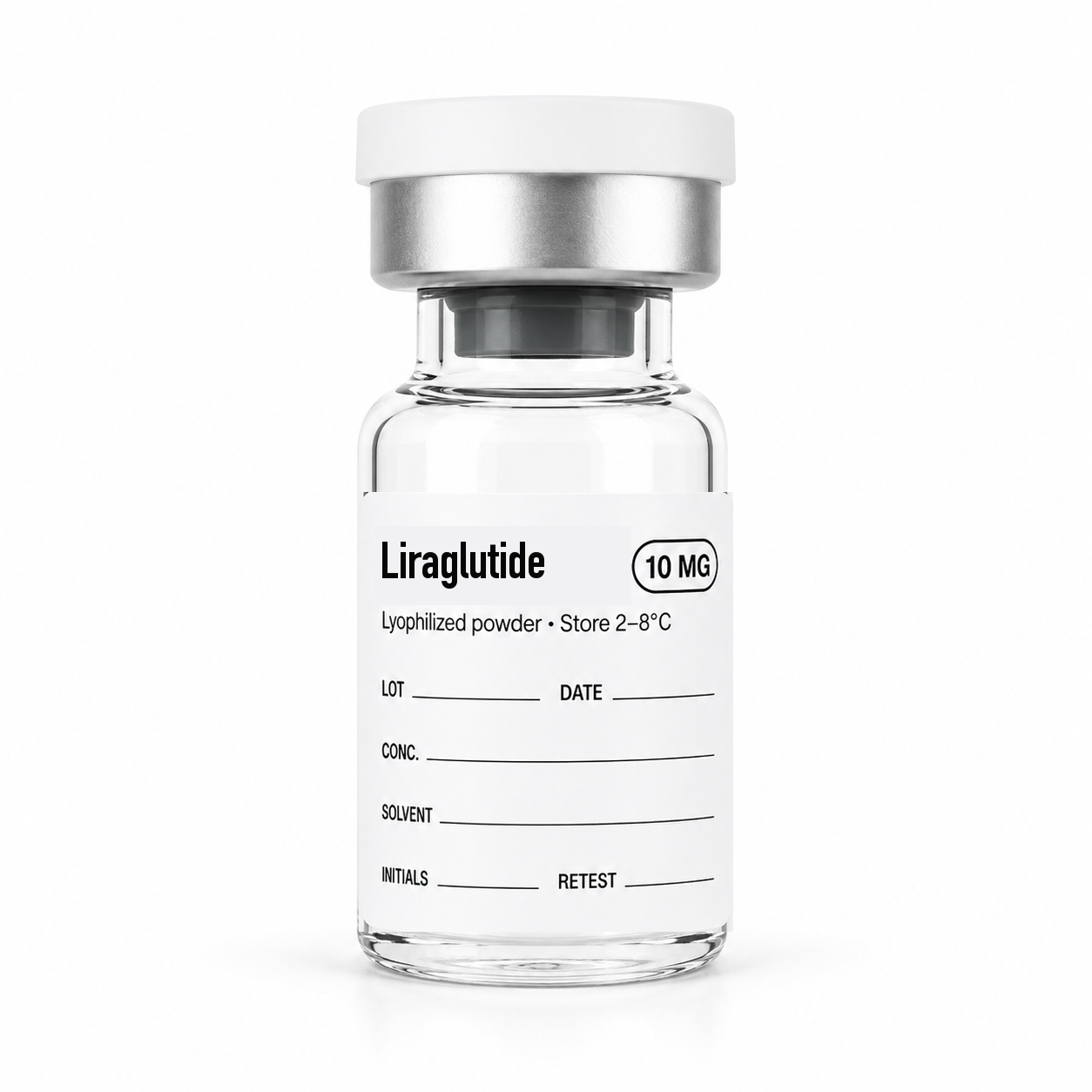
Quick Facts
Plain-English Summary
Liraglutide is produced by Novo Nordisk and is a structurally modified version of human GLP-1(7-37). A key modification at position 34 (Arg→Lys) prevents dipeptidyl peptidase-4 (DPP-4) degradation at the N-terminus, and the C16 fatty acid chain via a glutamate-γ-Glu-miniPEG spacer at Lys26 enables reversible albumin binding and self-aggregation at the injection site — both mechanisms extending half-life to ~13 hours and enabling once-daily dosing.
The SCALE obesity trial program (2015) demonstrated that liraglutide 3.0mg (Saxenda) produced 5–8% mean weight loss in obese patients over 56 weeks vs placebo, with meaningful improvements in cardiometabolic risk factors. Approximately 33% of patients achieved ≥10% weight loss. While these numbers have been eclipsed by semaglutide 2.4mg (~15% average loss in STEP trials) and tirzepatide (~20% in SURMOUNT), liraglutide's real-world use remains substantial.
The LEADER cardiovascular outcome trial (9,340 T2D patients, 3.8 years) demonstrated a statistically significant 13% reduction in major adverse cardiovascular events (MACE) with liraglutide 1.8mg vs placebo — the first positive cardiovascular outcome trial for a GLP-1RA. This cardiovascular data remains a distinguishing feature of liraglutide versus newer agents where long-term CVOT data is still maturing.
Liraglutide is a fully FDA/EMA-approved pharmaceutical — a critical distinction from virtually every other compound in this database. When prescribed through legitimate medical channels and obtained as a branded product, it represents well-characterized, GMP-manufactured medicine with a comprehensive safety database from years of post-marketing surveillance. The compounded versions circulating outside medical supervision do not carry these assurances.
Liraglutide is an approved drug, not a research compound. This distinction is critical: using branded Victoza or Saxenda under physician supervision is not equivalent to purchasing compounded liraglutide from unregulated sources. Compounded versions are not FDA-approved, may have variable potency, and are not legally permitted to be compounded when the branded drug is not in shortage. The FDA has explicitly warned about this.
Mechanism of Action
Proposed mechanisms below are derived from in vitro and rodent studies only. No mechanistic pathway has been validated in a controlled human study.
All mechanistic data is derived from in vitro or rodent studies. Applicability of these pathways in humans is not established.
Animal Data
| Model | Finding | ICPS Status |
|---|---|---|
| Rats — diet-induced obesity | Liraglutide 0.4mg/kg SC reduced body weight by 12% vs controls over 8 weeks; visceral fat depots decreased significantly; improved insulin sensitivity and hepatic lipid. | Preclinical |
| Mouse — β-cell preservation | Liraglutide promoted beta cell proliferation and inhibited apoptosis in diabetic mouse models; islet mass preserved relative to vehicle controls. | Preclinical |
| Rat — cardioprotection | Liraglutide reduced infarct size and improved cardiac function in ischemia-reperfusion models via GLP-1R-dependent mechanism. | Preclinical |
No finding from this section has been replicated in a controlled human trial. Animal-to-human translation for peptides is uncertain and cannot be assumed.
Human Trials
| Trial | Population | Status | ICPS Status |
|---|---|---|---|
| SCALE Obesity (NEJM 2015) | Obese adults without T2D (n=3,731) | — | RCT |
| LEADER CVOT (NEJM 2016) | High CV-risk T2D (n=9,340) | — | CVOT RCT |
| SCALE Diabetes (Diabetes Care 2015) | T2D with obesity (n=846) | — | RCT |
LIRAGLUTIDE has no FDA, EMA, or Health Canada–approved indications and no published Phase III trial data for any condition as of 2026.
Safety & Side Effects
Well-characterized safety profile from years of post-marketing surveillance in millions of patients. Most common adverse effects are GI (nausea, vomiting, diarrhea) — dose-dependent, typically transient during titration. Rate of serious adverse events comparable to placebo in LEADER.
Thyroid C-cell tumor risk: black-box warning (class effect of GLP-1RAs; rodent carcinogenicity signal; human risk considered low). Pancreatitis: rare but associated. Gallbladder disease: increased incidence in weight-loss-associated GLP-1RA users. Heart rate increase: ~2–3 bpm consistent finding.
- Nausea (most common, ~30–40% during titration)
- Vomiting, diarrhea, or constipation
- Injection site reactions
- Reduced appetite (intended effect that can cause inadequate nutrition)
- Personal/family history of MTC or MEN2 (thyroid black-box warning)
- Pancreatitis history (current or prior)
- Severe GI disease
- Pregnancy (stop before conception)
- Type 1 diabetes (not indicated)
LIRAGLUTIDE is not approved by the FDA, EMA, or Health Canada for any medical indication. It is classified as a research compound and is not legal for human therapeutic use in most jurisdictions. Procurement and use outside of registered clinical trials carries regulatory and unknown health risks.
References
Research disclaimer. CompoundProfile publishes summaries of available scientific literature for educational purposes only. This page does not constitute medical advice and should not be interpreted as an endorsement of LIRAGLUTIDE for any therapeutic use. Consult a licensed healthcare professional before considering any research compound. All evidence gradings reflect the state of published literature as of September 2026 and are assessed independently by ICPS.
Community Commentary
Selected discussion from r/Peptides · Curated for signal, not volume
Been on Victoza for T2D for 3 years before switching to Ozempic. Liraglutide works, the daily injection schedule is the main downside vs weekly. Weight loss on Victoza was meaningful (lost ~15 lbs) but the SCALE data showing 5-8% average is accurate for most people — expect that range, not 20%.
The cardiovascular outcome data for liraglutide is actually remarkable and underappreciated. LEADER showed 13% MACE reduction in high-risk T2D. We didn't have outcome data like this for any weight loss drug before. The CV protection is separate from and additive to the weight loss.
Liraglutide is NOT on the FDA drug shortage list unlike tirzepatide/semaglutide which were. That means compounding pharmacies CANNOT legally make it. People buying 'compounded liraglutide' are getting an illegal product with no safety guarantee. Just buy the real thing if your insurance covers it.
For weight loss specifically, semaglutide 2.4mg (STEP trials: ~15% loss) and tirzepatide (SURMOUNT: ~20% loss) now clearly outperform liraglutide 3mg (SCALE: ~8% loss). If weight loss is the sole goal and you have access to the newer agents, the evidence strongly favors them. Liraglutide still wins on years of safety data and CV outcome evidence.