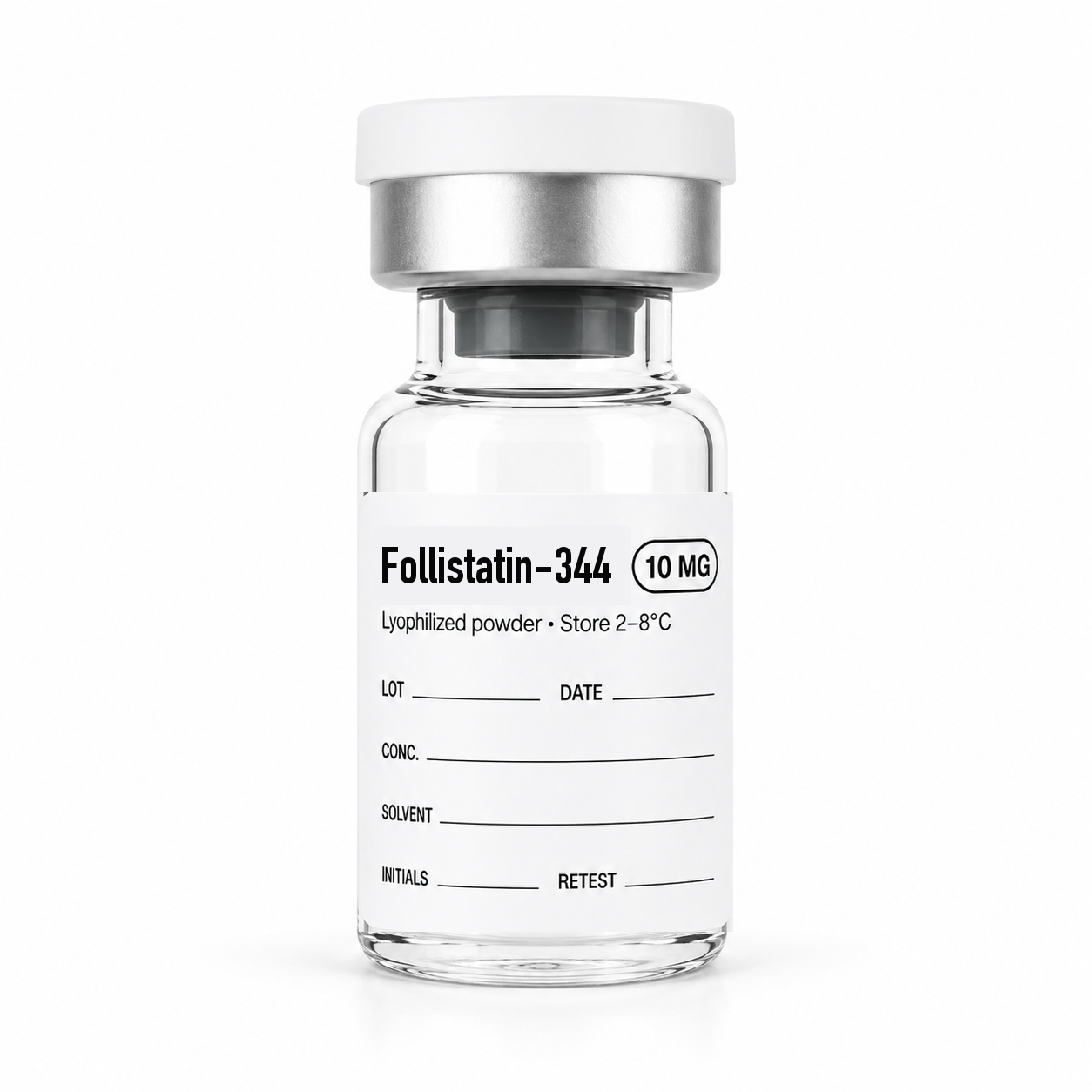
Quick Facts
Plain-English Summary
Follistatin is an endogenous glycoprotein produced by folliculostellate cells in the pituitary and many other tissues. It regulates TGF-β superfamily signaling by binding and neutralizing activins, myostatin, bone morphogenetic proteins (BMPs), and other ligands. FST-344 and FST-315 are the two primary isoforms, differing in their C-terminal heparin-binding domain — FST-315 is more tissue-retained, while FST-344 circulates more freely.
Myostatin (GDF-8) is a key negative regulator of skeletal muscle mass. Naturally occurring myostatin loss-of-function mutations produce dramatic muscle hypertrophy in mice, cattle (Belgian Blue breed), and isolated human cases. Follistatin, by binding and neutralizing myostatin at high affinity, mimics this effect pharmacologically. Transgenic mice overexpressing follistatin develop dramatically increased muscle mass (2–3-fold) with preserved function.
Gene therapy approaches using adeno-associated virus (AAV) vectors to deliver follistatin cDNA into skeletal muscle have reached human clinical trials for Becker and Duchenne muscular dystrophy, showing sustained follistatin expression and functional muscle improvements. These trials use gene therapy — a one-time delivery of the gene — not repeated injection of recombinant protein.
Injectable recombinant FST-344 has a short plasma half-life (~90 minutes) with some tissue retention. In rodent studies, myostatin inhibition and muscle hypertrophy have been demonstrated, but the magnitude of effect with protein injection versus gene-based overexpression differs significantly. Human bodybuilding use of injectable FST-344 lacks any clinical trial support and the WADA prohibition reflects the performance enhancement potential recognized by anti-doping authorities.
Follistatin-344 is WADA-prohibited. Competitive athletes face anti-doping rule violations and career consequences. For non-competitive users: the recombinant protein approach has very different pharmacokinetics than gene therapy (which is what generates the dramatic muscle data), and it is not established whether injectable FST-344 at practical doses and injection schedules produces the myostatin inhibition seen in animal models over meaningful timeframes.
Mechanism of Action
Proposed mechanisms below are derived from in vitro and rodent studies only. No mechanistic pathway has been validated in a controlled human study.
All mechanistic data is derived from in vitro or rodent studies. Applicability of these pathways in humans is not established.
Animal Data
| Model | Finding | ICPS Status |
|---|---|---|
| Myostatin-null mice vs follistatin overexpression | Follistatin transgenic mice develop 2–3x greater muscle mass than normal; muscle fiber hypertrophy and hyperplasia both observed. Phenotype more extreme than myostatin knockout alone, suggesting activin inhibition contributes. | Preclinical |
| Rat — recombinant FST-344 injection | Recombinant FST-344 (10 mg/kg every other day × 14 days SC) produced significant increases in muscle cross-sectional area vs vehicle; grip strength improved. Nakatani et al. 2007 ↗ | Preclinical |
| Primate — gene therapy (AAV-FST) | AAV-mediated follistatin delivery to macaque muscles produced localized 15% muscle mass increase and functional strength improvement — demonstrating proof-of-concept in a non-human primate. | Preclinical |
No finding from this section has been replicated in a controlled human trial. Animal-to-human translation for peptides is uncertain and cannot be assumed.
Human Trials
| Trial | Population | Status | ICPS Status |
|---|---|---|---|
| Gene therapy — Becker MD (Mendell et al.) | Adults with Becker/Duchenne MD (n=6) | — | Limited |
| Injectable recombinant FST-344 | — | — | No Data |
| WADA prohibited | All competitive athletes | — | Prohibited |
FOLLISTATIN-344 has no FDA, EMA, or Health Canada–approved indications and no published Phase III trial data for any condition as of 2026.
Safety & Side Effects
No formal human safety database for injectable recombinant FST-344. In rodent and primate studies, follistatin was well tolerated acutely. Theoretical concerns: activin also plays roles in follicle stimulating hormone regulation, reproductive function, erythropoiesis, and immune modulation. Chronic neutralization of activin could affect these systems in unpredictable ways.
Long-term safety completely unknown. Follistatin neutralizes multiple TGF-β family members beyond myostatin — activin A, activin B, BMP2, BMP4, BMP7. Chronic off-target inhibition of these signaling pathways in bone, liver, hematopoietic tissue, and reproductive organs is theoretically concerning and entirely uncharacterized in humans at doses sought by bodybuilders.
- Injection site reactions
- Unknown systemic effects from activin/BMP inhibition
- Potential reproductive effects (FSH regulation via activin)
- Unknown carcinogenic potential (TGF-β family has tumor suppressor roles)
- Active or suspected malignancy (TGF-β family members have tumor suppressor functions)
- Competitive athletics (WADA prohibited)
- Known reproductive disorders
- Pregnancy or breastfeeding
- Children and adolescents
FOLLISTATIN-344 is not approved by the FDA, EMA, or Health Canada for any medical indication. It is classified as a research compound and is not legal for human therapeutic use in most jurisdictions. Procurement and use outside of registered clinical trials carries regulatory and unknown health risks.
References
Research disclaimer. CompoundProfile publishes summaries of available scientific literature for educational purposes only. This page does not constitute medical advice and should not be interpreted as an endorsement of FOLLISTATIN-344 for any therapeutic use. Consult a licensed healthcare professional before considering any research compound. All evidence gradings reflect the state of published literature as of September 2026 and are assessed independently by ICPS.
Community Commentary
Selected discussion from r/Peptides · Curated for signal, not volume
The animal data is legitimate — follistatin really does produce dramatic muscle increases in mice and even primates. The gene therapy trials for muscular dystrophy are real medicine. The question is what injectable FST-344 protein does in a healthy human doing resistance training and the answer is: we don't really know.
If you compete in anything WADA-tested, do not touch this. Prohibited since 2019, detectable, career-ending. Not worth it. The muscle gains aren't even established in humans and you'd be risking everything for speculation.
Nobody talks about activin inhibition enough. FST-344 neutralizes activin A and B as potently as myostatin. Activin regulates FSH, hematopoiesis, liver function. Long-term what happens when you chronically suppress activin? Completely unknown. The muscle fantasy ignores the systemic biology.
The impressive follistatin results (2x muscle mass in mice, gene therapy trials in humans) are from GENE THERAPY — the gene is inserted once and overexpresses follistatin continuously from the muscle cell itself. Injecting protein every week is completely different pharmacology. Vendor marketing conflates the two constantly.