Quick Facts
Plain-English Summary
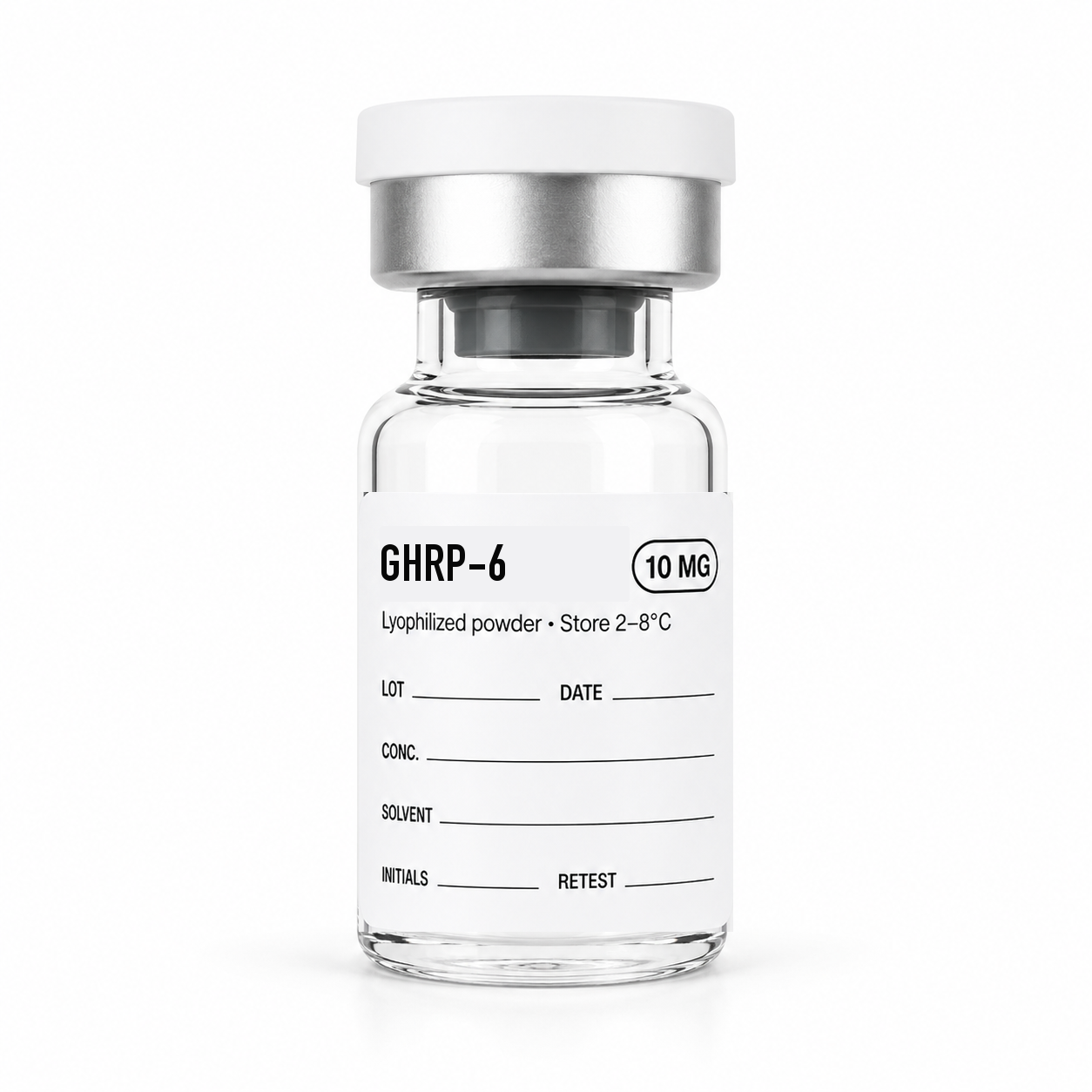
GHRP-6 is a synthetic hexapeptide and the founding compound of the entire growth hormone-releasing peptide (GHRP) class. Developed by Cyril Y. Bowers and colleagues at Tulane University in the early 1980s through systematic modification of enkephalin analogues, it was the first synthetic compound demonstrated to potently stimulate pituitary GH secretion through a mechanism distinct from GHRH. Its discovery in 1982 established that a separate receptor system — later identified as the ghrelin receptor, GHS-R1a — could be targeted to amplify GH release, opening a new era of growth hormone pharmacology and ultimately leading to the endogenous identification of ghrelin itself.
GHRP-6 acts as a full agonist at the GHS-R1a receptor on both pituitary somatotrophs and hypothalamic neurons. This dual action stimulates GH secretion directly at the pituitary while simultaneously suppressing somatostatin tone from the hypothalamus — producing a GH pulse that, while robust, is accompanied by meaningful elevations of cortisol, prolactin, and ACTH. This co-secretion profile distinguishes GHRP-6 from later, more selective GHRPs such as Ipamorelin, which was specifically engineered to minimise these side-hormone effects.
Among the GHRPs, GHRP-6 produces the most pronounced appetite stimulation — a direct consequence of activating the ghrelin pathway in the hypothalamus, which signals hunger and promotes energy storage. This property has generated research interest in cachexia and appetite-wasting conditions, where augmenting caloric intake is a therapeutic goal alongside GH-axis support.
GHRP-6 produces reliable GH pulse amplification alongside significant cortisol, prolactin, and ACTH elevation. This hormonal co-secretion pattern is less selective than Ipamorelin or GHRP-2 and represents a meaningful distinction for research protocol design and risk assessment.
Human study data for GHRP-6 is more extensive than for most research peptides. Published trials by Ghigo, Arvat, and collaborators in the 1990s established dose-response relationships for GH release in healthy subjects and GH-deficient patients, provided early evidence for IGF-1 elevation, and validated GHRP-6 as a diagnostic provocative agent for GH axis assessment. These studies are peer-reviewed and remain the empirical foundation of the compound's pharmacology. What is absent — as of 2026 — is any registered, completed trial demonstrating sustained anabolic, body composition, or performance benefit in humans.
Mechanism of Action
Proposed mechanisms below are derived from in vitro and rodent studies only. No mechanistic pathway has been validated in a controlled human study.
All mechanistic data is derived from in vitro or rodent studies. Applicability of these pathways in humans is not established.
Animal Data
| Model | Finding | ICPS Status |
|---|---|---|
| Rat myocardial ischemia/reperfusion (Berlanga et al.) | GHRP-6 preconditioning (2 μg/kg SC) significantly reduced infarct size and preserved left ventricular function following coronary occlusion in rat models. Anti-apoptotic signalling (Bcl-2 upregulation, caspase-3 reduction) proposed as mechanism. Effect observed independent of GH axis, suggesting direct cardioprotective action. Berlanga et al. 2011 ↗ | Preclinical |
| Rat GH pulse & IGF-1 elevation | Dose-dependent GH secretion demonstrated across multiple rodent studies. Chronic dosing at 40–200 μg/kg elevated serum IGF-1 and promoted weight gain in GH-deficient models. Effect attenuated by prior somatostatin analogue administration, confirming mechanism. Bowers CY et al. 1989 ↗ | Preclinical |
| Rat cachexia / food intake | GHRP-6 administration significantly increased food intake and lean mass accrual in cachectic rodent models. Appetite stimulation was the most pronounced of all tested GHRPs at equivalent doses, attributed to greater hypothalamic ghrelin pathway activation. Potential application in cancer cachexia research proposed. | Preclinical |
| Rat hepatic fibrosis (Berlanga group) | GHRP-6 attenuated hepatic stellate cell activation and reduced fibrosis markers in CCl₄-induced liver injury models. Anti-inflammatory and anti-fibrotic effects proposed to operate via NF-κB pathway modulation, independent of GH release. Berlanga et al. 2012 ↗ | Preclinical |
| Rat burn/wound healing | Topical and systemic GHRP-6 accelerated wound closure and reduced scar formation in burn models. Anti-inflammatory cytokine modulation (reduced IL-1β, TNF-α) reported. Cuban research group findings; independent replication limited. | Preclinical |
No finding from this section has been replicated in a controlled human trial. Animal-to-human translation for peptides is uncertain and cannot be assumed.
Human Trials
| Trial | Population | Status | ICPS Status |
|---|---|---|---|
| GH dose-response — Ghigo et al. 1994 | Healthy adults; multiple doses (0.1–1 μg/kg IV) | — | Published |
| GH deficiency diagnosis — Arvat et al. 1998 | Adults with suspected GH deficiency vs. healthy controls | — | Published |
| Elderly GH axis — Ghigo et al. 1996 | Elderly subjects (60–80 years); single and repeated dosing | — | Published |
| Combined GHRP-6 + GHRH | Healthy adults; GHRP-6 + GHRH co-administration | — | Published |
| Long-term anabolic outcomes | — | — | No Data |
GHRP-6 has no FDA, EMA, or Health Canada–approved indications and no published Phase III trial data for any condition as of 2026.
Safety & Side Effects
Cortisol, prolactin, and ACTH elevation are documented pharmacodynamic effects — not rare adverse events. Cortisol response can be significant at doses used for GH stimulation (100–300 μg SC). Chronic or frequent dosing may produce sustained elevation of these stress hormones, with unclear long-term consequences. This is a distinguishing risk factor relative to more selective GHRPs such as Ipamorelin.
GHRP-6 produces the most pronounced appetite stimulation of all GHRPs — a direct ghrelin pathway effect. This is relevant to research protocol design and to individuals who may not account for significantly increased caloric intake. The hunger response is acute (30–90 minutes post-injection) and may be difficult to tolerate without dietary management.
- Intense hunger within 30–60 minutes of injection
- Transient water retention / mild oedema
- Injection site redness and mild soreness
- Fatigue and lethargy, particularly at higher doses
- Tingling (paraesthesia), especially in extremities
- No pharmacovigilance database exists for GHRP-6
- Active or suspected malignancy (GH and IGF-1 elevation)
- Diabetes or insulin resistance (GH counter-regulatory effects)
- Active hypothyroidism (GH response blunted; underlying risk)
- Pregnancy or breastfeeding
- Psychiatric conditions sensitive to cortisol elevation
- Children and adolescents
GHRP-6 is not approved by the FDA, EMA, or Health Canada for any medical indication. It is classified as a research compound and is not legal for human therapeutic use in most jurisdictions. Procurement and use outside of registered clinical trials carries regulatory and unknown health risks.
References
Research disclaimer. CompoundProfile publishes summaries of available scientific literature for educational purposes only. This page does not constitute medical advice and should not be interpreted as an endorsement of GHRP-6 for any therapeutic use. Consult a licensed healthcare professional before considering any research compound. All evidence gradings reflect the state of published literature as of August 2026 and are assessed independently by ICPS.
Community Commentary
Selected discussion from r/Peptides · Curated for signal, not volume
The historical context on GHRP-6 gets completely ignored in modern discussions. Bowers' original work in the early 1980s was genuinely foundational — this was the compound that demonstrated a receptor-mediated GH secretagogue pathway existed independent of GHRH. Everything that came after — GHRP-2, Ipamorelin, Hexarelin — is downstream of that finding. The drug that defined the receptor class is now treated as obsolete because it has the worst hormonal selectivity profile. That's not wrong, but it flattens the pharmacological history considerably.
Right, and the selectivity point is the practical takeaway. If your research goal is GH pulse amplification with minimal hormonal noise, Ipamorelin is the rational choice in 2026. The cortisol and prolactin co-secretion from GHRP-6 isn't theoretical — Arvat documented it clearly in the early 1990s and the response is dose-dependent. Ongoing cortisol elevation has real downstream effects that deserve explicit acknowledgment in any protocol discussion.
The appetite stimulation is the most underrated angle on GHRP-6. In the context of cancer cachexia or chronic disease-associated wasting, a compound that simultaneously amplifies GH signalling and drives appetite is actually interesting — especially if the cortisol elevation is manageable within a supervised protocol. The problem is that the legitimate cachexia research hasn't been done in humans. The rationale is there; the trials are not. That gap is where the community fills in with anecdote.
Berlanga's cardioprotection work is the most credible preclinical data on GHRP-6 outside the GH axis studies. The ischemia/reperfusion models are methodologically solid and the infarct size reduction is consistent across experiments. What's interesting is that the cardioprotective effect appears to be GH-independent — the mechanism involves direct anti-apoptotic signalling at the myocardial level, not downstream IGF-1 effects. If that holds in humans, it's a distinct pharmacological angle. But we're a long way from knowing that.
Agreed — the GHS-R1a receptor has broader expression than originally appreciated. Cardiac tissue, liver, kidney all express it. That's why the Berlanga fibrosis and cardioprotection findings aren't implausible mechanistically. But a receptor being present in tissue doesn't tell you what the effect of activating it will be under various pathological conditions. Human data is still the missing piece across all of it.
From a practical research standpoint: GHRP-6's main value proposition in 2026 is as the historical reference compound and potentially as a GH diagnostic tool — which is actually validated in published literature. For GH secretagogue research where you want a clean signal, you'd use Ipamorelin. For appetite and GH combined, GHRP-6 has a pharmacological rationale. The community discourse that treats it as a bulking agent equivalent to anabolics is operating in a different reality from the available evidence base entirely.